Eye On IoT
April 3, 2019
Not every showroom will be the ideal fit for offering smart home products, but as the fastest-growing category in lighting, it deserves careful consideration.
The projections for global home automation sales in 2022 range from approximately US$40 to US$80 billion, depending on the study cited. Most remarkable is the growth of the smart home device market, with a compound annual growth rate (CAGR) of 31% between now and 2022. There were 37 million units of smart lighting products shipped globally in 2018 — and that is projected to reach 105 million units by 2022, representing 8.3% market share for residential lighting.
Gearing up for the challenge
One showroom accepting the challenges and opportunities of the Internet of Things (IoT) is Hermitage Lighting in Nashville, Kentucky. Rachel Fleischer has taken the initiative and led the charge, pointing out, “I’m 26 years old and the fourth generation in the lighting showroom business. I started the IoT department here after seeing a need for it.”
The lesson for other showrooms may be to designate a defined retail floor space for the category, make an inventory budget, and let a member of the younger generation take the lead. According to Fleischer, it was critical to
- train all of the salespeople and electrical desk staff
- create a consumer display showing how a hub works
- partner with major IoT suppliers
- emphasize the convenience and security benefits to customers
“Home security is an important concern for many customers — especially women,” Fleischer notes. “Smart lights can be turned on remotely, before the resident gets home at night. Cameras can also be integrated, like the Nest or Ring doorbell and cameras.”
She adds, “Legrand offers scene presets that automatically time the lights to turn on at sunset and off at sunrise using an astronomical clock. Bond is another great product that turns any RF ceiling fan into a smart fan that is controlled by a phone app.”
Hermitage sells smart appliances as well. “A smart oven can preheat by remote command, and a consumer can see into their smart refrigerator with an app while shopping at the grocery store,” Fleischer states.
Where to put it
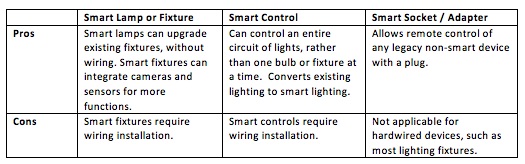
One of the big questions in smart homes is where to put the “smarts.” The radio and computer chips that create smart wireless devices can be placed into a portable lamp or ceiling/wall fixture, built into a control, or added to a socket/socket adaptor. Any of these solutions allow devices to be controlled via a smartphone app.
Which approach is better? Fleischer shares, “I often recommend smart switches over smart bulbs because smart switches control the whole circuit, not just one bulb at a time. Smart socket adapters are lower cost and more flexible/movable than hardwired smart sockets.”
Each approach has its pros and cons.
Voice assistants
A very important trend in smart homes is the rise of voice-activated digital assistants. Currently, this fast-growing market is dominated by three giants: Amazon Alexa, Google Home, and Apple HomeKit. In many ways, these voice assistants are becoming standard in smart homes, and many connected devices are rapidly becoming compatible with one or more of these voice assistants. This compatibility is something that showrooms should look for in smart lighting products and smart lighting controls.
Existing homes vs. new homes
Digital voice assistants are a good way to bring IoT control into existing homes. In new home construction, more comprehensive systems can be installed, such as Z-Wave with Zigbee. Often the easiest system for existing homes is WiFi since nearly all homes already have it available.
The challenges
Beatrice Witzgall, Founder and Design/Product Manager for LumiFi, (a smart lighting app for the consumer and hospitality markets) is also an IoT consultant to lighting manufacturers. Witzgall points out that many challenges remain for IoT lighting that could hold back adoption rates.
“Professionals (contractors, lighting designers, and many showrooms) haven’t yet embraced IoT [so] consumers are left to purchase products online or at DIY stores,” she comments. “Lighting professionals lean toward more expensive wired systems, but wireless is less expensive and more flexible.” Witzgall finds that lighting professionals don’t consider IoT to be their responsibility. She adds, “Europe is adopting IoT lighting much faster than the U.S.”
Witzgall recommends lighting showrooms partner with IoT integrators in their local markets, much as a showroom does with electrical contractors for fixture installation. IoT integrators can assist homeowners with both installation and the wireless set-up functions. They can also support more elaborate systems.” Regarding the rise of voice-activated assistants in the home, she observes, “Many consumers won’t use them due to privacy/cybersecurity concerns.”
Another concern that Witzgall points out is that some lighting manufacturers are incorporating smart components into their lighting products without including set-up instructions in their product spec sheets. Her advice to showrooms is to avoid products that don’t have clear set-up instructions, or else it could drive up the product’s return rate. She also believes smart lights, controls and sockets will continue to compete without any one method/brand winning over the market.
Reprinted from enLIGHTenment Magazine; enlightenmentmag.com
David Shiller is President of Lighting Solution Development; www.lightingsold.com.