The Lumen Maintenance Gap
October 16, 2018
This article is an excerpt from a technical brief, “Understanding LM-80, Lumen Maintenance, and LED Fixture Lifetime,” by Philips Color Kinetics.This article is an excerpt from a technical brief, “Understanding LM-80, Lumen Maintenance, and LED Fixture Lifetime,” by Philips Color Kinetics.
Test results of lumen maintenance in conventional and LED light sources differ considerably. This is known as the lumen maintenance gap. These tests are performed to determine the useful life of a light source. But how do we compare lighting technologies satisfactorily if test results of a same designation do not mean the same thing? These lumen maintenance measurement distinctions are those we will examine in this article, as a clear understanding of this gap will have a significant impact on the installation, maintenance and replacement cost calculations of lighting products.
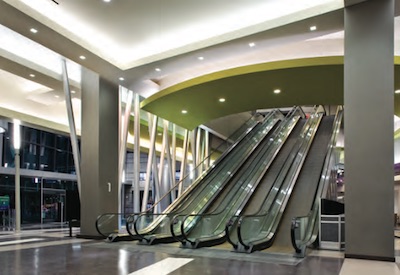
As an example of the benefits offered by lumen maintenance, the World Market Center in Las Vegas, Nevada (shown in photo), uses over 8,000 ft (2,438.4 m) of eW Cove Powercore linear LED lighting fixtures from Philips Color Kinetics to illuminate the complex geometries of the atrium in one of its buildings. LED cove lighting offers advantages over conventional cove lights in high-end installations such as this one. With useful life of up to 70,000 hours, and a very low failure rate, LED cove lights virtually guarantee reliable illumination around the clock for many years, without dark spots from lamp outages that can mar the elegant and uniform presentation of a premier space.
Lumen maintenance of LED and traditional light sources
When controlled, LED light sources can have a useful life that lasts considerably longer than the rated life of a conventional lighting source. Here’s an example: the World Market Center in Las Vegas, Nevada (shown in photo) uses over 8,000 ft (2,438.4 m) of eW Cove Powercore linear LED lighting fixtures from Philips Color Kinetics to illuminate the complex geometries of the atrium in one of its buildings. LED cove lighting offers advantages over conventional cove lights in high-end installations such as this one. With useful life of up to 70,000 hours, and a very low failure rate, LED cove lights virtually guarantee reliable illumination around the clock for many years, without dark spots from lamp outages that can mar the elegant and uniform presentation of a premier space.
The following table presents comparative data for the typical useful life range of various light sources.
Testing conventional light sources
LM-65-14 is a document that defines life testing procedures for compact fluorescent lamps (CFLs), while LM-49-12 defines life testing procedures for incandescent filament lamps. Both publications establish testing conditions, testing sample sizes, and valuation methods used for generalizing test data.
For CFLs, LM-65 specifies that a statistically valid sample be tested at an ambient temperature varying between 15⁰C and 40⁰C, in a cycle of three hours on and 20 minutes off (CFL life is appreciably shortened by the frequency with which the lamp is turned on and off). The point at which half the lamps fail is the rated average life for that lamp.
For incandescent filament lamps, LM-49 stipulates that a statistically valid sample be tested within the manufacturer’s stated operating temperature range and voltage. Lamps are turned off and allowed to cool to ambient temperature once a day (usually for 15 to 30 minutes). As with CFLs, rated life for incandescent filament lamps is the total operating time at which half the lamps cease to operate.
 Testing conventional LED sources
As of 2014, the technical publication entitled LM-84-14 was introduced as a means to fill a gap created by the lack of standardized LED fixtures and lamps testing methods. Even today, the rated life is calculated according to tests performed on lighting system diodes and not on the overall lamp or fixture system. Unfortunately, at this point, the LM-84 publication has disclosed only light system test parameters and is unable to provide other calculation methodology to issue results that might establish a specific rated life.
Many fixture manufacturers develop their individual interpretation of the life test results and establish in their own way the useful life of light sources. Often, they do not share the extrapolation or evaluation methods, so any comparison between the products of various manufacturers becomes both difficult and imprecise.

Useful life is not fixture lifetime
It’s important to keep in mind that useful life and fixture lifetime are two very different things. The useful life of a fixture refers to the lumen maintenance projections of the LED sources integrated into that fixture — in plain English, the number of hours an LED lighting fixture will deliver a sufficient amount of light in a given application.
Fixture lifetime, on the other hand, has to do with the reliability of the components of an LED lighting fixture as a system, including the electronics, materials, housing, wiring, connectors, seals, and so on. The entire system lasts only as long as the critical component with the shortest life, whether that critical component is a weather seal, an optical element, an LED, or something else. From this point of view, LED light sources are simply one critical component among many, although they are often the most reliable component of the whole lighting system.
Read the full document here: www.colorkinetics.com/Learn/docs/LEDLifetime.pdf