nLight AIR Autonomous Bridging Technology
Dec 3, 2020
nLight is a distributed, intelligent digital lighting controls platform to meet the demand for greater functionality while helping to reduce energy consumption and facilitate energy code compliance.
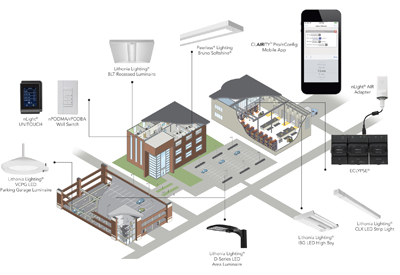
nLight integrates time-based, daylight-based, sensor-based, and manual lighting controls through its connected, intelligent digital devices. Intelligent digital devices include: Occupancy Sensor, Photocell, Wall Switches/ Dimmers, Panels, Power/Relay Packs, Controllers, and Luminaires.
The nLight platform continues to evolve, enhancing its nLight AIR wireless technology by adding more range and reliability to its network. Autonomous Bridging Technology allows networks to grow farther than ever and eliminates guesswork in lighting controls designs.
The technology ‘bridges’ new groups of devices to the system controller by using devices that are already connected to it. This indirect connection allows nLight AIR networks to grow larger, and because of the long-range broadcasts, information exchanges are incredibly fast.
{youtube} Ywhei9kS_18{/youtube}
Key Features
Communicate around corners – Design with confidence, knowing that messages will get where they need to go by repeating around obstructions using nearby devices.
Get off the site more quickly – No additional programming required during setup – devices self-initialize to bridge other devices when needed. Just start programming groups closest to your adapter, and the system will auto-establish to form a robust, connected network.
Communicate farther, faster – Groups and their corresponding devices are bridged only when necessary, extending your network and allowing groups to respond more quickly through the star topology of nLight AIR.
Intelligent network – The automatically bridged network self-improves over time, eliminating waste.
No additional hardware needed – Repeating is possible with existing hardware, which reduces the need to add more devices for larger networks.
Go HERE for more information.