Sesquicentennial Country and City Celebration
January 22, 2018
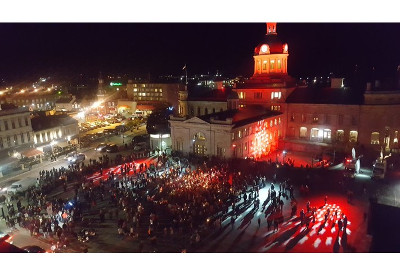
Canada’s first capital city grabbed the national spotlight during the country’s sesquicentennial festivities. Kingston, Ontario, dubbed the 150th anniversary’s “celebration city,” shone, literally, thanks to a new dramatic, high-tech lighting system designed to showcase the capital’s sites.
Kingston, the first capital of what was then the United Province of Canada, held the esteemed title between 1841 and 1844 prior to the country’s Confederation in 1867. It was only fitting that all Canadian eyes turned to the historic first city during sesquicentennial celebrations.
To stand out during the merrymaking, the city needed lighting that would make it shine like the star it is. A legacy lighting project, spearheaded by the municipal government of the City of Kingston, brilliantly spotlighted the former capital building, now Kingston City Hall, along with Confederation Fountain and Springer Market Square, with the help of Los Angeles-based Acclaim lighting.
Highlighting history
A prominent landmark on the waterfront since 1844, Kingston City Hall is the community’s symbolic centre of civic government and administration. Designed by architect George Browne when Kingston was the capital of the United Province of Canada, it’s one of the finest 19th century buildings in Canada and stands as a nationally designated heritage site. This prominent building, occupying a full city block facing Lake Ontario, features a distinct, neo-classical design, with a landmark thiolate, dome and portico, projecting pavilions, and classically inspired interior detailing.
Across the street in Confederation Park, the city’s Confederation Fountain is centrally located on an axis with City Hall’s central portico. The fountain separates city hall from the waterfront. It was completed in time for Canada’s centennial and honours the city’s past role in locomotive manufacturing. In fact, the site houses a restored locomotive, as well as the original train station that now serves as a tourist information centre.
Market Square, created as part of the original town plan of 1784, was the site of an informal market established in 1788. In 1801, it officially became known as the Kingston Public Market. An 1840 fire forced rebuilding of the market area, including a new building attached to the city hall. The building, later deeded to the city, has noted significance that extends to major events in Canada’s history, including the proclamation of the Constitutional Act of 1791 establishing Upper Canada, the formal announcement of the War of 1812, and the location where Canadian Confederation was proclaimed.
Now named Springer Market Square, it maintains its market commerce role as the oldest public market in the province, with additional civic uses for its smaller amphitheatres and larger square as public gathering and year-round outdoor entertainment spaces for movies, outdoor skating, and concerts.
The three venues and their history served as a canvas for light and its physical and symbolic role in public gatherings and civic displays in Kingston’s history as Canada’s first capital. With picturesque views to and from Lake Ontario and its prominent role in history, City Hall’s impressive architecture became the central feature of the lighting project, supported by the fountain and the Market.
Illuminating challenges
Keeping City Hall’s storied history and beautiful architecture in mind, the mayor’s office turned to Bruce Meiklejohn, principal of LightInForm Design Inc., Ottawa, for design direction and Garry Stewart of SNC Lavalin’s Ottawa office for electrical engineering, as a team effort for this crown jewel and surrounding areas in advance of the 150th anniversary celebrations and beyond.
LightInForm Design, a creative and technical lighting design studio, creates lighting schemes on the premise that light is a material Inherent to form and space. Meiklejohn used this theory while working closely with the City of Kingston, Montreal-based SNC-Lavalin Group’s Ottawa office, Christie Lites in Ottawa, M.H. Electric Co. in Kingston, and Waterman Sales in Ottawa.
Waterman is a manufacturer’s agent for lighting, control and electrical products in eastern Ontario and western Quebec, representing more than 40 companies. With its extensive product inventory and expertise, Waterman offered a range of lighting products and electrical and controls coordination to help the design team illuminate Kingston’s historic centre. Lighting layouts were done by LightInForm, coordinated electrically with SNC, with photometric analysis done in house by LightInForm. Waterman provided design support, products, and commissioning coordination.
“The client wanted to provide brilliant colour to the building for special occasions, while allowing white light for other days,” said Meiklejohn. “We selected products from Acclaim Lighting based on their ability to provide precise colour and white light performance with long term durability and integrity.”
To prepare for the celebration, the City of Kingston quickly switched out high-pressure sodium and metal-halide floodlights with Acclaim’s dynamic RGBW LED equipment and wired/wireless DMX control for permanent installation. The new lighting system enables programmable-colour and white designs for this prominent architectural and historical location, while using less energy with greater impact and longer lasting equipment for future festivities.
Meiklejohn and his team faced three major challenges in making this magic happen. First, the lighting system needed to provide both a colour wash for events and static white light appearance for the architectural heritage building. Second, the team faced tight deadlines. And third, the team wanted to use the latest lighting technology as it was being introduced to secure efficient long-term performance.
For the first challenge, different approaches typically are used for designing saturated and uniform colour mixing to create a dynamic canvas versus designing for permanent architectural white lighting. To combine both approaches, a permanent static white light look was initially rendered to utilize building details and ledges for grazing light and texture on the stone façade. Scenes with coloured light were also rendered, and a mock-up was established to help decide optimal fixture locations and optics for both scenarios.
Achieving this synergy in design objectives entailed creating a fixture setback distance that worked also with site conditions. Fixture optics targeted a uniform wash of light with some shadowing around key character-defining elements. The significant features include:
- long rectangular three-story façade with slightly projecting end pavilions, and a large central drum and dome rising above complete with windows, clocks, and a copper roof on a monumental scale
- distinct division between the rusticated ground floor of channelled ashlar masonry and the smooth ashlar masonry on the upper storey
- exterior detailing, including inset windows and doors, blind arcade mouldings around the windows, string courses between stories, wide plain pilasters and parapets on the end pavilions, and a strong cornice line with dentils to unite the entire length of the building
- regular, symmetrical arrangement of door and window openings along the façade, including rectangular, second-story windows set in segmental arches and round-arched first-story windows in round arches
- pediment Tuscan portico with four Doric columns
These details gave the designers opportunities for some shadowing that does not interfere with a colored light mix but provides noticeable texture especially on the white light look.
Under control
To address the second challenge of tight deadlines, Meiklejohn and Stewart worked with Waterman to specify wireless control and onboard wireless-enabled DMX fixtures to significantly improve controls installation and commissioning without needing the time-consuming and costly infrastructure normally required within a heritage building. As a result, the design team specified DMX/RDM splitters and Aria Wireless DMX transceivers from Acclaim Lighting, and Unison Mosaic Tessera controller and ETC DMX/RDM gateways from ETC Visual Environment Technologies, Mazomanie, Wisconsin.
Acclaim Lighting’s Aria Wireless DMX system is a compact, IP 66 rated transceiver that works in ambient temperatures ranging from -40°F to 122°F (-40°C to 50°C). It can act as either a transmitter or receiver with 15 channels to choose from running on the 2.4 GHz band and is AES 128-bit encrypted. The internal wireless system features both automatic networking and signal routing optimization to ensure the best possible reception of DMX data. With a specified choice of a 5dB omni or 10dB directional antenna, Aria Wireless DMX provides transmission up to 2600 feet line of sight and 300 feet between obstructions and walls.
The Unison Mosaic Tessera controller is both a part of a greater sophisticated networked system and a standalone full controller in itself, with a compact local touchscreen. The Tessera is unique in handling not only complex lighting and lighting devices of all sorts LEDs, but also impromptu show-control, other accessories and non-lighting effects — for complete control — in an economical package.
Mixing it up
For the third challenge the design team sought to use the latest high-tech products to meet the project’s stringent criteria. The lighting scheme required RGBW colour mixing including saturation, colour blend and smoothness of transitions with a range of options. Floodlighting required a +/- 5,000 lumen output in order to achieve the required intensity and saturation on the façade.
As part of the criteria, the designers selected products based on RGBW and optical performance related to colour blend and uniformity from close setback fixture locations for the front façade, along with the range of products and optics. All came from the same highly reputable manufacturer with the robust services of supply chain personnel, including local area reps and commissioning team.
Another key aspect of the project, the wireless controls enabled minimally invasive electrical/controls wiring in the heritage building. It also allowed easy central control of all adjacent project sites without the need for disruptive installation work, including civil, for running new controls or power wiring infrastructure.
Several products were used for lighting the front façade on the city hall building, as well as around the three venues and included the following, all from Acclaim Lighting:
- Pixel Graze RGBW — an IP66 high-power LED fixture with quad-colour spectrum (using 3000K for the white light source) or dynamic white options in a compact profile for best in class colour mixing and saturation. Specified for the end pilasters on the front façade.
- Dyna Drum SO RGBW — a high-output, IP66 rated, LED flood fixture with an adjustable yoke, on-board digital display and a built-in receiver for the Aria wireless DMX system. Selected for the front façade wash at a 20-degree angle.
- Dyna Drum HO RGBW — a high-output, IP66 rated, LED flood fixture with an adjustable yoke, on-board digital display and a built-in receiver for the Aria wireless DMX system. Designated for the front façade central portico, side façade wash, dome wash, and Springer Market Square Plaza wash at various beam angles with diffusion gel.
- Dyna Graze HO RGBW — a high-power, white LED, IP66 rated, linear fixture offering smooth linear dimming with ELV modules. Used for the dome’s interior-up light wash.
- Dyna Flood XT QW-RGBW — a high-output, IP66 rated LED flood light with an adjustable head and internal line voltage dimmable driver. Specified to provide a 70-degree wash to the back wall behind the dome clock faces and upper belfry.
- Aqua Drum HO RGBW — a high-output, IP68 submersible, LED flood fixture with an all-stainless-steel construction for submersion up to 20 feet, available in multiple colour temperatures of white and colour changing versions. Selected for the fountain at different angles with fixtures placed at 10×35 to highlight underside of arch; 25 degrees on the fountains; and at 10×60 on the inner-perimeter, knee-high wall.
- Martin Exterior Projection 500 — a powerful fixture for integrating textures, patterns and graphics in outdoor lighting designs. Selected for Image projection and custom gobos on the façades and at Springer Market Square.
The lighting design delivers fully programmable colour changing and white light for architectural enhancement, allowing the city to tell the story of celebrations and special events through static and dynamic lighting and image projection. We were able to create a distinct and unified lighting scheme for these high profile civic structures and public spaces while operating under tight timelines and with client objectives informing the installed design. The project needed to be completed in time for use during Canada Day and the sesquicentennial celebrations. These events were the inaugural launch of this central permanent, fully programmable public space and façade lighting installation.
Project Name: Illumination of First Capital Place — Kingston City Hall
Contacts
- City of Kingston — Marissa Mascaro / Manager, Realty Construction Projects; Speros Kanellos / Director, Facilities Management & Construction
- LightInForm Design — Bruce Meiklejohn / Principal Lighting Designer
- SNC Lavalin — Garry Stewart / Electrical Engineer
- FX Lighting — Todd Phillips / Project site support
- Waterman Sales) Darren Edwards / Inside sales
- Christie Lites / Field Service — Wayne Korhonen / Controls and Commissioning
- M H Electric — Mike Hodgson / Owner, Electrical Contractor
{loadposition slideShow29}
Bruce Meiklejohn, B.Arch., LC, MIES, is Principal and lead lighting designer of LightInForm Design inc., which he founded in 2014.His degree in Architecture from Carleton University and near 17 years of professional lighting design experience continue to influence professional interests in light as integral and inherent to all forms and materials, and space.