Smarter Traffic Lights Win Global Recognition for U of T Student
November 22, 2017
University of Toronto Engineering graduate Samah El-Tantawy is creating better, smarter traffic lights using game theory and artificial intelligence to teach lights how to adjust to traffic patterns in real time, reports Sharon Oosthoek in U of T News.
Traffic light systems typically use sensors embedded in the pavement leading up to the intersection to send data to and from a central management centre. The centre then sends signals back to adjust the lights’ timing. However, El-Tantawy’s system processes data on site and in real time, avoiding data transmission delays. El-Tantawy’s system also lets traffic lights use data from all directions. This creates more responsive timing for grid-like transportation networks. It even allows lights to “talk” to each other, creating the optimum traffic flow in a given geographical area.
Tests of El-Tantawy’s system on 60 downtown Toronto intersections at rush hour showed a reduction in delays of up to 40%. The test also showed it cut travel times by as much as 26%.
El-Tantawy was inspired by watching snarled traffic in Toronto and in her hometown of Cairo, Egypt. “It affects the environment, the economy and society in general.”
“Each intersection engages in collaboration (or ‘game’, in game theory terminology) with all the adjacent intersections in its neighbourhood where each one not only learns the local optimal control policy but also considers the policies of its neighbours and acts accordingly,” says El-Tantawy. “In turn, neighbours coordinate with their further neighbours in a cascading network-wide fashion.”
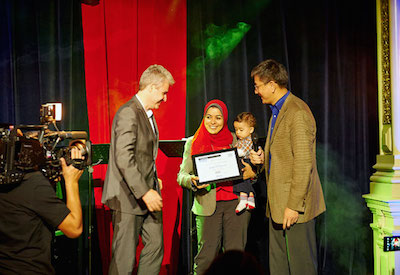
The system, which costs between $20,000 and $40,000 per intersection to install, has attracted interest from the traffic signal control industry and recently won two international awards. El-Tantawy took first place in the best PhD dissertation competition from the Institute of Electrical and Electronics Engineers’ Intelligent Transportation Systems Society. El-Tantawy, who graduated from U of T in 2012 with a PhD in civil engineering, also won second place from The Institute of Operations Research and Management Sciences’ George B. Dantzig Dissertation Award.
El-Tantawy worked under the supervision of Professor Baher Abdulhai, director of The Toronto Intelligent Transportation Systems Centre and Testbed, to develop the system, known as MARLIN-ATSC, for Multi-agent Reinforcement Learning for Integrated Network of Adaptive Traffic Signal Controllers.
Sharon Oosthoek is a writer with the Faculty of Applied Science & Engineering at the University of Toronto. Read the full article: https://www.utoronto.ca/news/smarter-traffic-lights-win-global-recognition-u-t-grad.
Photo courtesy of Samah El-Tantawy.