Study Explores How Museum Lighting Affects Perception
July 24, 2018
Museums are increasingly positioning themselves as participative institutions, social spaces that represent a cultural focal point and meeting place, and urban landmarks. However, studies show few people actually visit museums because of their passion for art or architecture, as most people are happy to simply go and think about the artworks.
A recent study conducted by Zumtobel at the National Museum of San Matteo* in Pisa, Italy explored how different light sources, their particular settings and the contrast they create between the artworks on display and their backgrounds affect visitor preference when it comes to lighting arrangements.
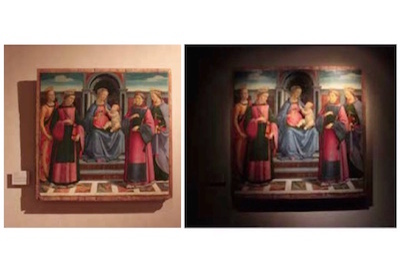
Researchers asked 55 participants to assess and evaluate four different lighting configurations for two artworks — a panel painting and a marble sculpture located in separate exhibit rooms — and compare them in terms of contrast, enhancement of the characteristics of the artworks and, finally, personal preference. (Shown in photo: the panel painting as originally lit and with participant-preferred lighting).
The research goals were to
- identify and define lighting configurations that offer the best impression of the artworks, in terms of both faithfulness to the original message of the artist and visitors’ enjoyment of the exhibition.
- investigate whether viewers prefer lighting configurations that enhance the artworks, or whether personal preference is actually driven by other factors, such as individual feelings and specific messages communicated by the artworks
Architectural and lighting parameters have a significant impact on the visual perception of art exhibitions and can support the optimal enhancement of individual works. Several different types of luminaires can be used for museum exhibitions — individual or multiple spotlights, light lines or wallwashers — and each one can be combined with different reflectors, lenses, glare rings or accessories to shape and control the light output. Furthermore, the selection and configuration of the appropriate luminaires, as well as a combination of different light sources, represent a crucial step when it comes to designing art exhibitions, because different layouts can generate different lighting effects: first for the artworks and second for the overall exhibition space.
The lighting arrangement creates a defined relationship between the exhibits, the background and the surrounding exhibition space, depending on the purpose of the exhibition and the feelings that it should stimulate. For example, a wide beam or a wallwasher will illuminate the background as well as the work of art, creating a more uniform lighting scenario, while smaller and narrower light beams may focus purely on the surface of the artwork, leaving the background largely in the dark.
In conclusion, the same artwork can be illuminated in many different ways, depending on the dimensions of the light beams and their setting, direction and shape.
The experiment at the National Museum of San Matteo involved various lighting configurations:
- three traditional configurations, created using spotlights and wallwashers with warm light
- one configuration made by mixing smaller spotlights with different CCTs, which tested the so-called Monza Method
Arcos LED expert spotlights, Arcos wallwashers and Supersystem II spotlights were installed to realize the multiple test lighting configurations, which featured combinations of the various luminaires and different settings, optics and lenses.
The study found that observers generally preferred more neutral configurations, which created an intermediate contrast ratio between the exhibits and their backgrounds. Furthermore, the lighting solutions that were described as relaxing and simple were rated as the most pleasant and interesting, while more uniform scenarios were seen as being boring and not suitable for the enhancement of the artworks.
Preferred lighting solution for the panel painting
The Sacra Conversazione by Domenico Ghirlandaio and the Madonna del Latte by Nino Pisano and Andrea Pisano (1479) is a panel painting on show at the museum alongside other Renaissance paintings. Researchers tested four different lighting configurations. Configuration 1, shown in the photo, was rated as the best solution to highlight the specific characteristics of the painting.
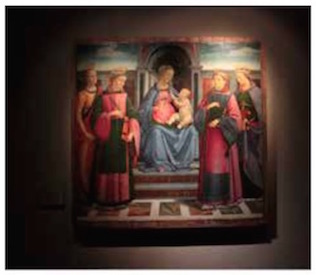
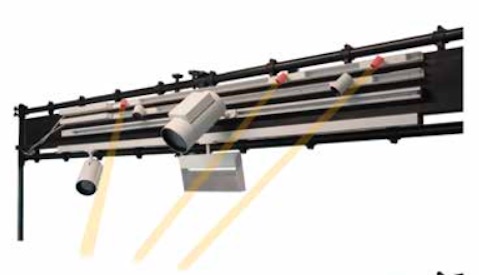
This configuration was realized using three Supersystem II mini spotlights (two with a CCT of 3000K and one with a CCT of 4000K). This combination was used to create a more vibrant lighting effect on the painting, using sources with a different CCT focused on specific areas of the painting. The two spotlights with a CCT of 3000K were directed on two areas around the faces of the five figures, while the spotlight with a cooler CCT was directed on the areas with cooler colours, like the blue dress worn by the Madonna. The Superspot optic was specified for the 4000 K spotlights and the Spot optic was used on the two 3000 K spotlights. The measured UV radiation was equal to 0.2 x 10⁻³ W/m2.
Read more about the study, including the research results for four different lighting configurations applied to each artwork: www.zumtobel.com/PDB/Teaser/EN/Study_ArtCulture_Visual-perception-of-artworks.pdf?utm_campaign=2018-05_ZL-Newsletter_en&utm_medium=email&utm_source=Eloqua&elqTrackId=3F14CCFF213983F0C80356B2CC5200AA&elq=dcd01e6839d947af962b196c8ff902fb&elqaid=1158
* The museum is located in the medieval monastery of San Matteo. The exhibition halls are arranged around the old courtyard of the monastery on the first floor of the building, while the museum entrance overlooks the Arno river. The museum contains one of the most important collections of medieval paintings and sculptures in Europe, featuring works by leading Italian artists from between the 11th century and the 13th century.