Learn How Li-Fi Works from Its Inventor, Harald Haas

April 10, 2017
Some day the last leg of our communication networks might not depend on a modulated radio signal but on a modulated light signal from an LED bulb in a desk lamp or ceiling fixture. IEEE Senior Member Harald Haas has developed a visible light communication system he calls light fidelity, or Li-Fi, which relies on nanometer waves in the infrared and visible light part of the electromagnetic spectrum to transmit data generated by an LED bulb fitted with a microchip.
Haas demonstrated in 2011 how light fidelity technology works in a TEDGlobal talk. Viewers dubbed him the father of Li-Fi.
“Li-Fi will not only offer higher speeds than Wi-Fi,” he says, “but it will do so with greater security and the potential to deliver unprecedented bandwidth and data density.”
A professor of mobile communications at the University of Edinburgh, Haas established the LiFi Research and Development Centre at the school to conduct R&D on the technology. In 2012 he helped found pureLiFi, also in Edinburgh, to commercialize the technology. The company recently unveiled several products.
In November, Haas received the International Solid State Lighting Alliance’s outstanding achievement award for his “contribution to diversifying the applications of solid-state lighting technology.”
How Li-Fi works
The system has two basic parts: an LED bulb that transmits modulated signals and a separate photodetector — a photodiode — connected to a computer or other Internet-enabled device that displays the decoded signals. Haas developed a transmission technique, called spatial modulation–orthogonal, frequency division multiplexing or SM-OFDM, that enables a light source to transmit data rapidly and in an energy-efficient manner.
The LED bulb is a semiconductor light source, and the current supplied to it can be modulated — by a microchip that Haas’s team developed, which is placed in the bulb fixture, or luminaire. Light from the bulb can be intensity-modulated at high speed. The modulation is invisible to the human eye. Data are fed into the LED bulb, which sends data embedded in its light at rapid speeds to the photodiode, which is some distance away. Currently, that device is housed in a dongle pureLiFi recently introduced that plugs into a standard USB port.
The communication link behaves as seamlessly as do the radio signals of a Wi-Fi system, according to Haas.
“Data rates in ideal conditions have been as high as 100 gigabits per second (Gb/s), which means approximately 12 full-length high-definition movies could be downloaded in a second,” he says.
Step up from Wi-Fi
Li-Fi doesn’t interfere with other RF devices in the area. And increased data density — approximately 1,000 times the data density of Wi-Fi — reduces the need for users to share the wireless bandwidth with others.
For security purposes, the visible light can be contained in a defined area: just close the doors, pull down the window shades, and shut the drapes and you lock in your data. Unlike RF, the light won’t travel through walls. What’s more, the LED bulbs can be dimmed to such a point that they appear off, even while they’re still transmitting data, Haas says.
The light signals of an LED bulb do have a relatively short range compared with RF, he points out. So the farther away from the light source, the slower the speed. “You don’t have to be under the LED bulb to access Li-Fi, because the system can use light reflections from walls and other surfaces,” Haas says. “So, clearly, it is a non-line-of-sight technology.” Practical data speeds in his Li-Fi products have averaged 25 Mb. Unlike RF, Li-Fi is unaffected by interference from cordless phones, microwave ovens, machinery, or similar sources.
New products
PureLiFi introduced its first LiFi-X dongle in February 2016. About the size and width of a business card, LiFi-X plugs into a computer’s USB port. An optical device that accepts signals from the LED bulb, the dongle holds a receiver that converts the light-intensity variations of the LED into an electric signal, which is then converted back into a data stream that is transferred to a computer.
The dongle also contains a digital data modulator that works with an infrared LED to provide full duplex bidirectional wireless access at 43-Mb download and upload speeds.
Those are the highest practical data rates of the Li-Fi systems, Haas says. He notes that a single Li-Fi luminaire can communicate simultaneously with multiple dongles, for what’s referred to as multiuser access. Moreover, if a mobile device moves into the illumination area of another Li-Fi-enabled luminaire, the system invokes a seamless handover, so the device is always served by the best-placed luminaire.
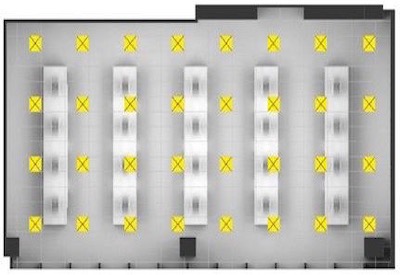
Through a partnership with the French lighting manufacturer Lucibel, pureLiFi has built a Li-Fi system for office buildings. Included are luminaires that hold the LED bulbs as well as the modulating and demodulating circuits and digital signal processors that run the communication protocols as firmware. LED bulbs installed in the ceilings can be networked into the company’s IT architecture, so people using a computer or mobile device outfitted with the LiFi-X dongle can access data from office LEDs anywhere in the building.
The first Li-Fi-enabled system was installed in June throughout the 3,500 square meters of the Paris headquarters of Sogeprom, a real estate developer. A number of pilot projects are under way in Singapore, according to Haas, spearheaded by the country’s Info-communications Development Media Authority.
The cost of each lighting system is now negotiated individually, says Haas, who expects costs to go down with volume.
Other uses
Connected cars, the digital aircraft cabin, virtual and augmented reality applications, and the Internet of Things are other possible applications for Li-Fi, Haas says.
For example, the technology could provide a bidirectional communication link between cars through their LED headlights and added sensors. And Li-Fi-enabled LED streetlights and traffic lights could communicate with driverless cars to keep them from crashing into each other.
“Li-Fi could also provide a big, fat data pipe for virtual-reality applications,” Haas says. “And it could be ideal for the Internet of Things, linking low-power sensors in industrial equipment or home appliances.
“We are living in what author and economist Jeremy Rifkin called the “Third Industrial Revolution” in his best-selling book of the same name. That revolution is all about data, and economies are built around data. Making sense out of data means you not only have to create, analyze, and process data, you also have to transmit it. All intelligent biological systems have a nervous system, and Li-Fi may provide the nervous system of our future smart world that will be full of artificial intelligence!”
This article was first published by IEEE in The Institute: http://theinstitute.ieee.org/members/profiles/learn-how-lifi-works-from-its-inventor-harald-haas.
Photo source: pureLiFi.
Kathy Pretz is editor in chief of The Institute.