Laser Lighting — the Potential Successor of LED Technology
November 9, 2016
One thing that characterizes technology is constant evolution, and lighting fixtures are no exception. New technologies constantly emerge, offering performance superior to the products they replace, eventually displacing them from the market.
At the moment, LED lighting represents the state of the art in the lighting industry. However, according to Dr. Shuji Nakamura, laser diodes are the future of lighting and will eventually displace LED. It is important to note that Dr. Nakamura is a Nobel Prize winner and the inventor of blue LED, the technology that made the current LED revolution possible! In fact, he has already co-founded a company called SoraaLaser, dedicated to laser lighting.
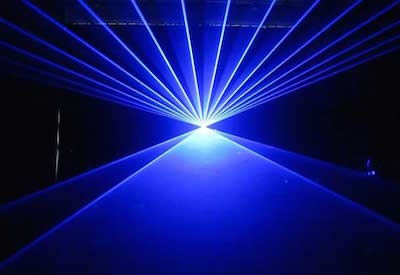
Laser technology is still experimental, but it offers great potential and impressive performance characteristics:
- In theory, laser lamps can achieve an efficacy in the range of 200 lumens per watt, which is twice the average efficiency of most commercial LED fixtures (100 lm/W). This means that, once the technology is commercial, a retrofit from LED to laser lighting could offer savings of around 50%, not to mention the impressive savings that will result when replacing less efficient technologies such as HID and fluorescent lighting.
- A very high colour rendering index is achievable with LED, in the range of 0.95 or above. While there are LED fixtures capable of offering this CRI, they do so at the expense of efficacy. Many high-CRI LED lamps go below 70 lm/W, which is comparable to the efficiency of fluorescent lighting.
- According to Dr. Nakamura, laser diodes allow the current density to be increased by 10 to 20 times compared to that of LEDs. This results in a very compact lamp that allows a high degree of optimization in terms of optical design.
- The high current density tolerated by laser diodes would also lead to a reduction in costs, simply because much less material is needed.
All of these features are possible thanks to the implementation of gallium nitride (GaN) laser diodes, which generate a violet lighting output. The basic principle for producing white light is the same used for blue LEDs: the diode is covered with a phosphor coating designed to interact with the photons passing by in such a way that the resulting colour is white.
While off-the-shelf laser fixtures are not yet available, there are some examples of commercial applications. For instance, some high-end BMW and Audi vehicles have laser headlights: they have seven times more range than conventional headlights, and more than twice the range of LED headlights. The BMW i8, for example, uses laser headlights developed by Osram, one of the largest brands in the lighting industry.
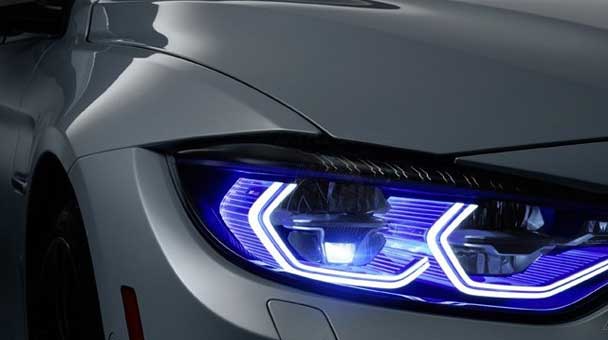
Lighting designers will soon a have access to a new technology to work with, which will provide even greater savings than LED. Laser lighting could be particularly attractive for architects and interior designers, since its high colour rendering index will ensure the colours of objects and surfaces are represented faithfully.
This article was first published online as a LightPro blog: https://blog.light.pro/laser-lighting-the-potential-successor-of-led-technology/.