LRC Responds to AMA Report on LED Lighting Health Hazards
August 08 2016
Recently the American Medical Association (AMA) produced a document cautioning the public about In-Ga-N based LEDs used as sources of illumination. The Lighting Research Center (LRC) at Rensselaer Polytechnic Institute* has received a large number of requests for an opinion. Professors Mark Rea and Mariana Figueiro of the LRC have prepared a response.
Key points include:
• Predictions of health consequences from light exposure depend upon an accurate characterization of the physical stimulus as well as the biological response to that stimulus. Without fully defining both the stimulus and the response, nothing meaningful can be stated about the health effects of any light source.
• Notwithstanding certain sub-populations that deserve special attention, blue light hazard from In-Ga-N LEDs is probably not a concern to the majority of the population in most lighting applications due to human’s natural photophobic response.
• Both disability glare and discomfort glare are mostly determined by the amount and distribution of light entering the eye, not its spectral content.
• In-Ga-N LED sources dominated by short wavelengths have greater potential for suppressing the hormone melatonin at night than sodium-based sources commonly used outdoors. However, the amount and the duration of exposure need to be specified before it can be stated that In-Ga-N LED sources affect melatonin suppression at night.
• Until more is known about the effects of long-wavelength light exposure (amount, spectrum, duration) on circadian disruption, it is inappropriate to single out short-wavelength radiation from In-Ga-N LED sources as a causative factor in modern maladies.
• Correlated color temperature (CCT) is not appropriate for characterizing the potential impacts of a light source on human health because the CCT metric is independent of nearly all of the important factors associated with light exposure, namely, its amount, duration, and timing.
The LRC’s response attempts to draw attention to the problem of misapplying short-hand metrics to the topic of light and health, and also provides the reader with a wealth of references that should inform rational discourse.
Read about the AMA’s Guidance on Harmful Effects of High Intensity Street Lighting: http://lighting.electricalindustry.ca/led-technology/1502-ama-issues-guidance-on-harmful-effects-of-high-intensity-street-lighting.
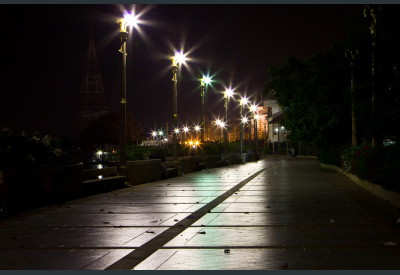
Image courtesy of tiverylucky at FreeDigitalPhotos.net.
* The Lighting Research Center (LRC) at Rensselaer Polytechnic Institute is the world’s leading center for lighting research and education. Established in 1988 by the New York State Energy Research and Development Authority (NYSERDA), the LRC has been pioneering research in solid-state lighting, light and health, transportation lighting and safety, and energy efficiency for nearly 30 years. LRC lighting scientists with multidisciplinary expertise in research, technology, design, and human factors, collaborate with a global network of leading manufacturers and government agencies, developing innovative lighting solutions for projects that range from the Boeing 787 Dreamliner to U.S. Navy submarines to hospital neonatal intensive-care units. With 35 full-time faculty and staff, 15 graduate students, and a 30,000 sq. ft. laboratory space, the LRC is the largest university-based lighting research and education organization in the world.