How Much Home Lighting Do You Need? Another Approach
One way to determine required light levels for a room is to use simplified lighting design calculations to determine the number of lumens required and, in turn, the number of lamps and luminaires needed to produce these lumens. There’s another approach, more like a rule of thumb in residential lighting design, that is worth mentioning.
The approach is based on wattage. What do watts, a measure of electrical loading and an element of cost, have to do with lighting a room? The simple answer is that most people are accustomed to buying incandescent lamps based on standard wattages such as 60W and 100W, and can assign them to an understood level of brightness.
The mindset is changing, however, because energy legislation is eliminating standard incandescent lamps in favour of more-efficient types that produce similar light output (lumens) for a lower wattage. So the primary metric is becoming lumens, not watts.
Nonetheless, performing a simplified lighting design based on watts remains possible. Here’s the rule of thumb formula: Take the area of the room (length x width) and multiply by 1.5 for general lighting and 2.5 for task lighting. The result is the minimum amount of wattage needed for lighting in the room. Accent lighting would be treated separately.
Therefore, if we have a 12 ft. x 14 ft. living room, we’d need (12 x 14) x 1.5W = 252W for general lighting and (12 x 14) x 2.5W = at least 420W budget for task (e.g., reading) lighting.
Other home lighting approaches
Another way of doing the task lighting is to restrict the space dimensions to the task area. So a kitchen island is 6 ft. x 4 ft., (6 x 4) x 2.5W = at least 60W dedicated to that area.
In the old days of standard incandescent wattages, we’d be considered done, but now we have energy-saving incandescent lamps, LED lamps and compact fluorescents, all of which produce light at varying wattages:
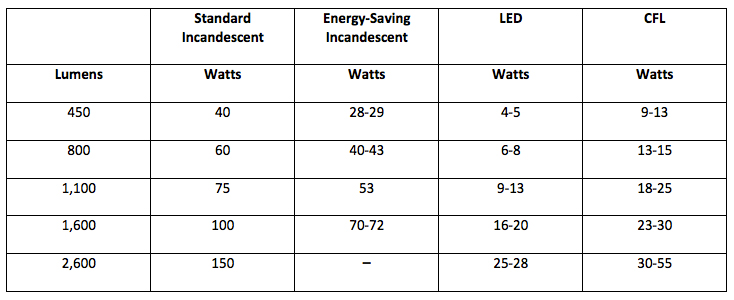
There are several approaches to adjust wattage we could use. One is to select our lamp and adjust accordingly. If the room was going to feature 100W incandescent lamps, but will instead use 23W CFL, then 23W / 100W = 0.23. Therefore, in our living room example, where we needed a minimum of 252W for general lighting, we would instead need 252W x 0.23 = 58W.
Another approach is to pick the most popular incandescent wattage, which is 60W, and base everything on that as a standard to get a rough number. So if our living room needs a minimum of 252W for general lighting, we’d multiply that by a factor of say 0.72 for energy-saving incandescent (181W), say 0.13 for LED (33W) and say 0.25 for CFL (63W).
Things get messy for those odd applications where it makes sense to mix lamps in the same space. In that event, base it on lumens, using the intended incandescent lamp types or 60W as a standard. Our living room example requiring at least 252W for general lighting translates to 4.2 sixty-watt incandescent lamps, or 4.2 x 800 = a minimum budget of 3,360 lumens. That budget could then be divided among the different lamp types.
The end result is pretty simple and straightforward but is a rule of thumb. The more precise approach is to evaluate activities, determine appropriate light level, and choose lamps and luminaires that produce the required light output, taking into account coefficient of utilization and how the light is distributed. As an example of that last point, a luminaire with a reflective interior surface and omnidirectional lamp would emit a different light pattern and lumen output than the same luminaire fitted with a directional lamp.
Craig DiLouie, Principal of ZING Communications, Inc., is a lighting industry journalist, analyst and marketing consultant; cdilouie@zinginc.com. This article has been reprinted, with permission from IES, from Light Logic for the 21st Century: http://ieslightlogic.org