Lighting Control for Lighting Quality
April 9, 2019
Networked lighting controls can reduce energy consumption by an average 47%, according to a recent industry study. That makes control a powerful tool in managing energy costs, but it only captures a small fraction of its potential value in enhancing quality lighting with LED technology.
Quality lighting is a venerable concept in the lighting industry. It can be defined as lighting that satisfies owner and user requirements, often looking beyond light levels and watts to address visual comfort, space perception, colour, and more. It is realized through design best practices and metrics as well as quality products. Quality lighting can be challenging when the owner doesn’t understand its value, resulting in settling for less with a focus on initial cost.
When evaluating the impact of building design on the bottom line, a useful rule of thumb is the 3/30/300 formula, with 3 being the average cost ($) per square foot for utilities, 30 being real estate, and 300 being employee wages and benefits. We might add 3000 to the formula, which is generated revenue.
Investing in new lighting typically focuses on the 3, as the impact of saving wattage is not necessarily holistic to calculate and often delivers a predictable return on investment. However, independent of watts, the quality of the lighting can impact the rest of the equation, with even a tiny impact delivering much greater economic value than energy savings alone.
That’s where networked lighting control comes in. The system consists of an intelligent network of individually addressable control points, which allow multiple control strategies to combine to maximize energy cost savings. If the system is integrated with other building systems, cross-inputs can generate additional savings, such as occupancy sensors triggering the HVAC system. If the system is centralized, data can be fed to a server or the Cloud for analysis by software. It is this connectivity and analytics that are the key to unlocking extraordinary new value in lighting quality, based on the adage that information is both power and money.
Let’s look at just lighting to start with:
- By controlling the light and colour output of LED luminaires, the owner can implement recipes for promoting a more humancentric building environment, while mitigating glare and overlighting.
- By monitoring all lighting equipment, automatic notifications can be generated for maintenance response, which can make maintenance more efficient and enhance lighting quality by helping the owner ensure all lighting is operational.
- By monitoring occupancy sensor status, the owner can better understand and manage space utilization, improve operational efficiencies such as cleaning, and gain insights valuable for future building designs.Through thermal mapping, the owner can work toward balancing HVAC loads, putting the right light and temperature where needed, and enhancing comfort.
- By monitoring light levels, the owner can anticipate end of life for LED luminaires and gain insights into user light level preferences valuable for future lighting designs.
These capabilities multiply when the networked lighting control system is integrated with a building management system and the Internet of Things (IoT). The control system may have the wireless communication, bandwidth, intelligence, and software to deliver data to other building systems and third-party software. This could be data from occupancy and daylight sensors or other integrated sensors. By adding sensors using ubiquitous luminaires as the physical platform, the owner can geometrically increase available data and associated capabilities, such as inventory tracking and location-based services. For example, in a hospital, RFID tags could be placed on wheelchairs and crash carts, with the RFID signal passed through luminaires enabling hospital staff to locate equipment using apps.
Another example is business process improvement. Theoretically, any aspect of the building’s operating environment could be measured, from air quality to water temperature to sound detection. Using a hypothetical water park, Michael Skurla (formerly of Acuity Brands) identified an excellent example of how data can be used to improve business process efficiency. Based on data generated across the facility, the park’s facilities manager can check whether the lights are ON, water consumption for the rides, and temperature in the park’s restaurant. The manager can ensure there is appropriate staffing for the number of visitors. The lifeguard can determine how many people are in line. The accounting staff can calculate average length of stay per guest and match the number of people in the park to tickets sold. Visitors can find out how busy the park is, average water temperature, and average wait per ride. And the marketing department can calculate the fraction of visitors who take advantage of various attractions and amenities.
In short, all of this information can be used to determine and educate owners on user behaviour and preferences, ensure building systems are delivering on these preferences, measure and benchmark the results, and inform future lighting and building designs. The result is potentially significant impacts on environmental quality, user satisfaction, owner understanding of what users want, process efficiencies, and cost reduction. By generating evidence of user preferences and satisfying them, and then being able to measure the result, quality becomes more actionable as a business goal to increase user satisfaction and reduce costs. For lighting, networked connectivity and LED technology provide these tools while also providing installation points for additional sensors.
The IoT is young and still maturing, addressing issues such as interoperability, cybersecurity, and how to process the vast volume of data into actionable intelligence. Networked lighting controls, however, are further established and ready to deliver immediate benefits, including the potential for later IoT integration and the ability to better understand and deliver lighting quality.
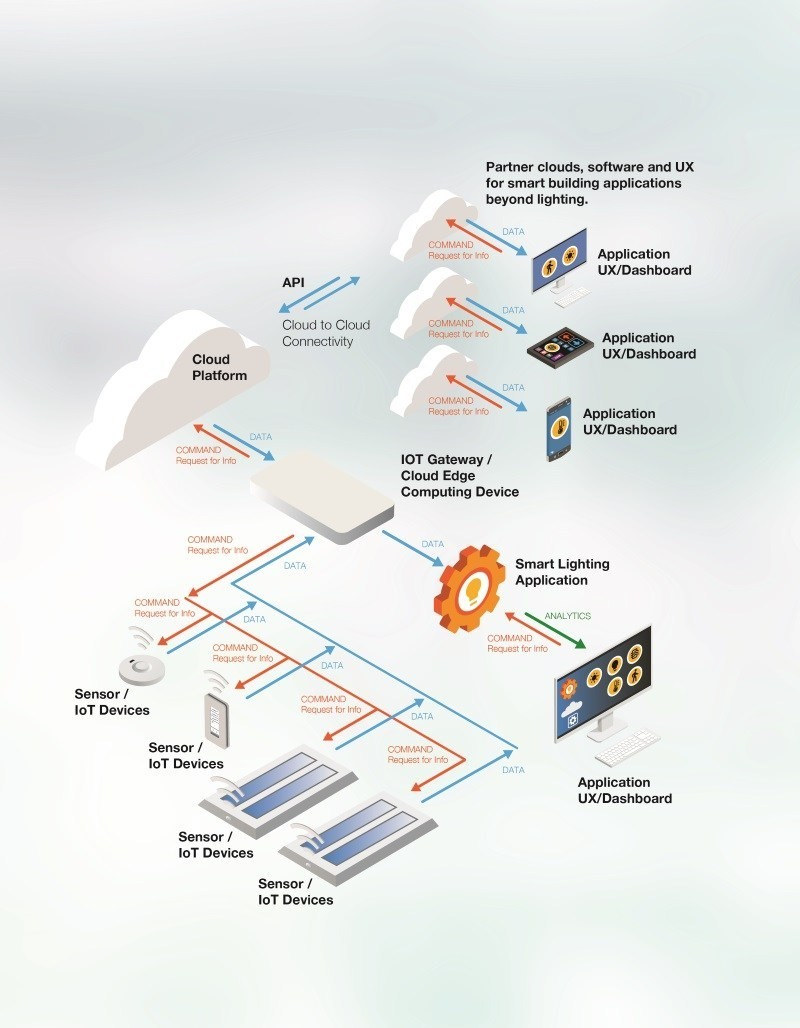
Appearing below: The Internet of Things at a glance, highlighting the lighting and networked control system. Data from sensors flow to a server or the Cloud, where they are analyzed and used for lighting management. Data can also be shared with other building systems and third-party software. The shown lighting and control system is readily achievable today. What happens beyond to create a single smart building that harvests and translates data into meaningful action is quickly developing.
Images courtesy of Osram
Craig DiLouie, LC, is Education Director for the Lighting Controls Association. Reprinted with permission of the Lighting Controls Association, www.lightingcontrolsassociation.orgCraig DiLouie, LC, is Education Director for the Lighting Controls Association. Reprinted with permission of the Lighting Controls Association, www.lightingcontrolsassociation.org