How DarkSky partners with the National Audubon Society to promote Lights Out for the birds
May 14, 2024
By Drew Reagan
Migratory birds depend on the night. Coordinate with a Lights Out Program Near you.
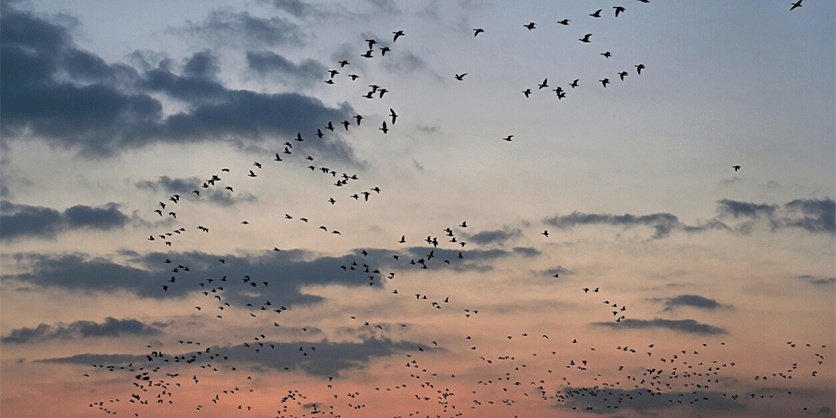
Twice a year, billions of birds take part in massive migrations. Generally, birds spend the spring and summer in places where conditions are ideal for raising young, which means mild weather, reliable nesting spots, and plentiful food sources to feed growing chicks. But with the approach of winter, they move again, often returning to warmer climates.
Like humans, birds take their cues about when to complete certain tasks based on routine changes in light throughout the day and year. However, unlike humans, many birds are nocturnal, meaning they are most active during the night.
According to the National Audubon Society, a nonprofit dedicated to protecting birds and their habitats, 70% of birds in North America migrate. Of them, 80% migrate at night.

Which flyway will you protect?
In North America, there are four main migratory flyways: the Atlantic, Mississippi, Central, and Pacific.
The reasons most birds migrate at night are multifold: “Migrating at night allows birds to avoid certain predators,” explained Connie Sanchez, who manages the Bird-friendly Buildings program at the National Audubon Society. “It’s also more energy efficient. Birds can conserve more energy on their migratory route by flying in cooler temperatures in the dark.”
Connie Sanchez, who manages the Bird-friendly Buildings program at the National Audubon Society
Natural sources of light at night, like the moon, stars, and the illuminated horizon of dawn and dusk, help guide birds along their journey as well, providing another reason to fly during the night.
Unfortunately, as the night sky grows increasingly brighter due to the rapid growth of light pollution caused by artificial light at night, birds are paying the price.
Light pollution’s harrowing toll on migratory birds.
The New World Atlas of Artificial Night Sky Brightness estimates that 99% of people in the United States and Europe live beneath skies that are polluted by artificial light to some degree, with 80% of the population living in areas too polluted to see the Milky Way. And while experiencing a sky filled with stars might seem like something to simply enjoy, growing scientific research suggests a much greater importance. A pristine night sky is critical to the endurance of critical wildlife habitats and the survival of nocturnal creatures.
Birds, like humans, evolved beneath dark skies and thus are well adapted to detecting low levels of natural light from the moon, stars, and along the horizon. When we blast artificial light into the night sky, we disrupt and confuse natural systems.
Many birds are drawn to the artificial lights of buildings found along migratory pathways. As a result, they fly toward large structures and into dangerous cityscapes. Research estimates that building collisions kill as many as one billion birds in the United States each year, though the toll could be much higher.
“The estimate is hard to quantify because we do not see most collisions happen,” Sanchez said. “In many cases, the bird becomes stunned after colliding into a glass window. They then fly away and die elsewhere, often from an internal injury that is not visible, or a predator like a cat snatches them.”
Connie Sanchez, Bird-friendly Buildings program Manager, National Audubon Society
Birds don’t just run into glass towers. Among the one billion birds that die from flying into buildings in the United States each year, nearly half of them collide with homes and smaller buildings.
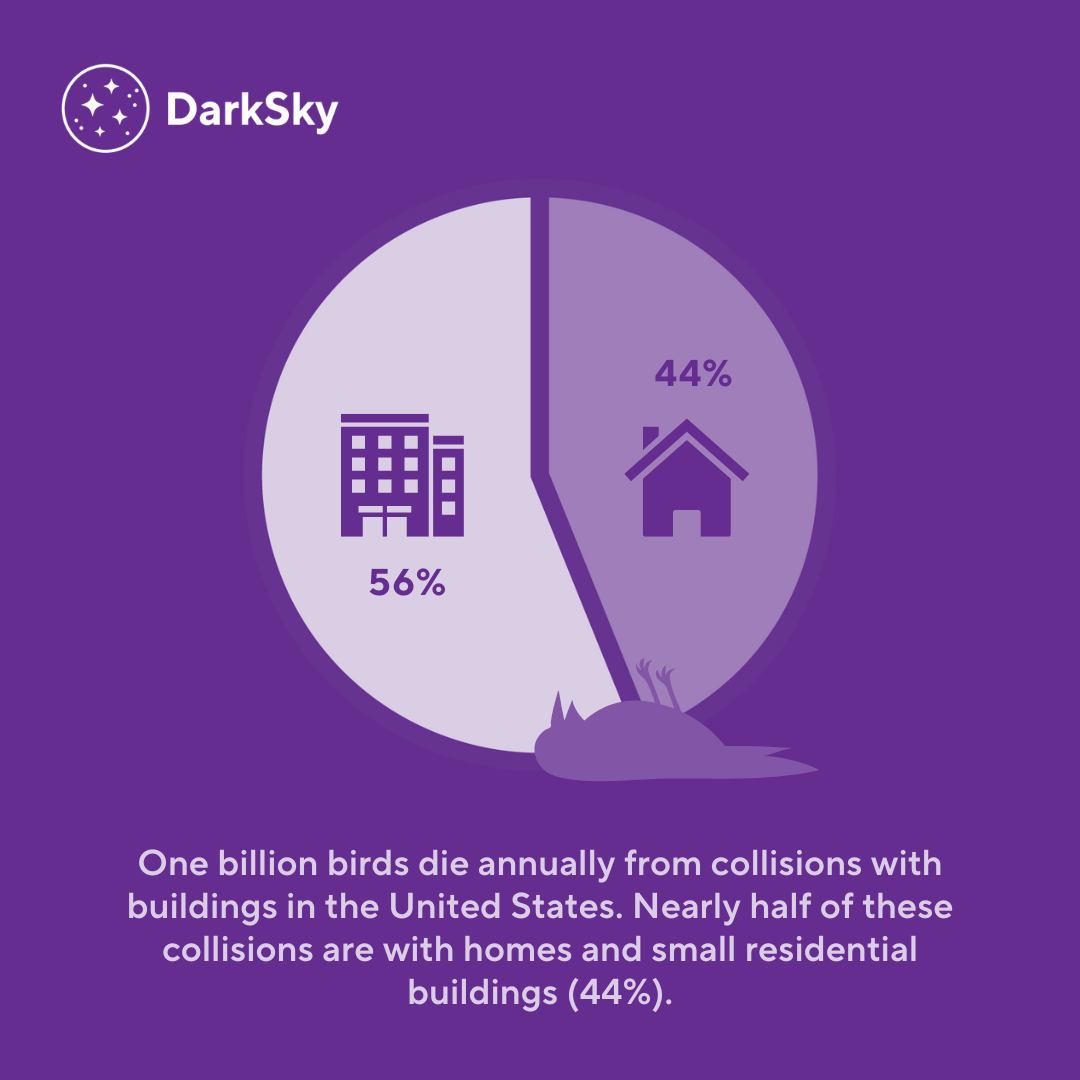
Turning out unnecessary lights at night around your home and neighborhood can help birds along critical migration corridors.
“Many people don’t realize the threat of residential buildings to birds,” Sanchez said. “Instead, they’ll often think of big cities and urban areas; however, it’s a widespread issue that’s happening everywhere, at all times of the day, at all times of the year.”
While some birds avoid or recover from building collisions, many never make it to their point of destination. Rather, they become too tired and disoriented after artificial lights misguide them.
“The light draws them off course and disorients them,” Sanchez said. “Light coming from windows coupled with reflectivity confuses birds that are trying to get to their breeding and wintering grounds.”Some birds detoured by artificial light at night do make it to their correct destinations but might arrive late. Light pollution can also trigger birds to migrate too soon. Research has found that artificial light can move the migration schedule of birds by as much as a week. And while a week may not seem like much, arriving too early or too late could spell disaster if weather and food conditions are not right.
Connie Sanchez, Bird-friendly Buildings program Manager, National Audubon Society
Lights out for the birds.
Light pollution is a pervasive problem worldwide; therefore, tackling the issue requires international support.
Audubon chapters and local partners have been working to expand the Lights Out Program in various towns and cities throughout the United States and Canada since 1991. Chapters raise awareness about the issue and encourage individuals and businesses to participate in the program, which involves ensuring facility lights are off at night during the fall and spring when birds migrate. When lighting is necessary, Audubon turns to DarkSky’s Five Principles for Responsible Outdoor Lighting at Night (ROLAN) to reduce light pollution as much as possible.
“There are some cities where we have a lot of buy-in from building owners and managers and other places where it’s not top of mind yet,” Sanchez said.
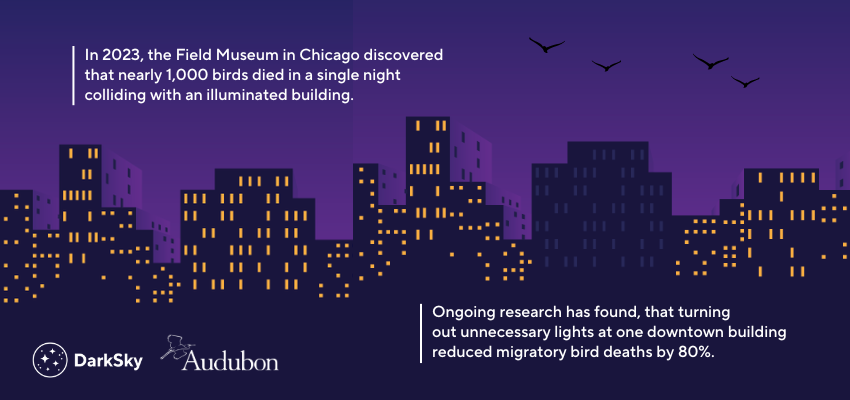
The program has grown to include several partners, among which DarkSky belongs. DarkSky and Audubon chapters work in tandem to carry out the program in places like Bend, Oregon, Flagstaff, Arizona, and St. Louis, Missouri. In 2023, Starry Skies North, a DarkSky-affiliated group in the Great Lakes region, successfully organized to reduce light pollution at the Essentia building in Duluth, MN.
“Birds, in general, are a way to connect people with one another and with nature because birds are everywhere,” Sanchez said. “Lights Out programs are about simple solutions that building owners, managers, and residents can implement to think about responsible lighting and help migrating birds.”
Connie Sanchez, Bird-friendly Buildings program Manager, National Audubon Society
Find a Lights Out Program near you.
DarkSky International encourages our Chapters, Groups, Advocates, and members to learn more about organized Lights Out Programs in locations near you. If efforts are not being made in your area, consider organizing to reduce light pollution along migratory bird flyways.
With residential structures and small buildings contributing to nearly half of all collision-related bird deaths, actions taken at the local or even neighborhood level can have incredible impacts. Learn more about DarkSky’s Five Principles for Responsible Outdoor Lighting at Night (ROLAN) and other ways to protect the night by becoming an official DarkSky Advocate.
More information available here