Philips Lighting Delivers One Billion LED Lights as Part of Global Lighting Challenge
November 20, 2017
Philips Lighting has delivered one billion LED lamps and luminaires as part of an ongoing commitment to the Global Lighting Challenge. The international challenge aims to deploy 10 billion high-efficiency light points to improve energy efficiency around the world.
Philips Lighting is the first company to reach this milestone, which is also the halfway point in its goal to deliver two billion lamps by 2020.
In December 2006, lighting accounted for 19% of global electricity consumption. This level was down to 15% in 2015 when the Paris Agreement was signed, and is on track to further decline to 8% by 2030.
This milestone demonstrates that we can successfully drive the transition from conventional lighting technologies to LED, which can make a significant contribution to global climate change objectives,” says Harry Verhaar, Head of Global Public and Government Affairs at Philips Lighting. “Energy efficiency is the low hanging fruit. Today, energy efficiency improves by about 1.5% every year but simply doubling this to 3% per year would set us on a sustainable path.
“When compared to the outdated lighting sources these LEDs replaced, the energy savings achieved are equivalent to the energy generated by 30 medium-sized coal-fired power stations, and the CO2 reductions achieved are equivalent to the emissions produced by 12 million cars. The impact is real and measurable.”
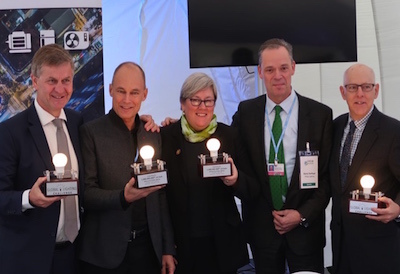
The one billionth LED lamp was presented to a group of representatives from international governmental and non-governmental organizations at a special ceremony in Germany attended by advocates of environmental change, including representatives from the UN, the International Energy Agency (IEA) and the Global Environment Facility, as part of the United for Efficiency conference.
At the event, Philips Lighting called on governments worldwide to join them in its goal to make the world more energy-efficient by making the following commitments:
- by 2020, install all new buildings with LED or equivalent energy-efficient lighting
- by 2025, require all street lighting be LED or equivalent energy-efficient lighting
- by 2030, require all existing corporate buildings be fitted with LED or equivalent energy-efficient lighting
Find out more about the Global Lighting Challenge: http://globallightingchallenge.org/
Photo courtesy of Philips Lighting.