Signify on Sustainability: Solar-powered Night-Time Lights for Fish
July 15, 2021
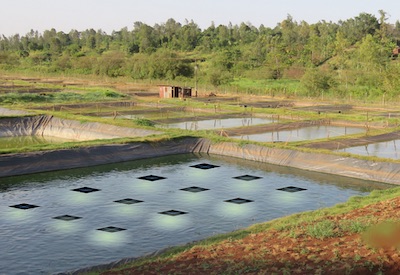
In a development that combines two aspects of its multi-faceted environmental sustainability ethos, Signify has added solar-powered lights to its aquaculture range and has trialled them on a freshwater tilapia farm in China. The farm is part of the US$7.7 billion Guangdong Haid agricultural company. The new Philips solar fish grow lights are designed to provide light for up to six hours after sundown, tuned to a spectral setting optimized for specific species.
Solar-powered lighting and LEDs for plant and animal growth are two of the four areas that Signify CEO Eric Rondolat has identified as the “growth platforms for sustainability” that could generate €5 billion in revenue in 2023.
If the new fish lights were to come with a warning, it might be this: Light at night can upset circadian rhythms in fish just as it can with humans. The disruptive effect of nocturnal light varies across aquatic species. Anyone with a fish tank at home is familiar with the general advice to flip off the switch at some point during the evening, as aquarium fish typically benefit from such daily blackouts, and might otherwise get stressed.
But the reciprocal statement would be that with some species, a certain amount of extended light can boost growth and reduce the amount of food a fish requires. So farmers should apply the lights’ 2700 lm for varying lengths of time — or perhaps not at all – depending on what they are raising.
In the case of tilapia, a minimum of four hours of darkness is in order. That down period suited the situation at Guangdong Haid’s tilapia farm in Jiangmen, where daylight duration peaks at roughly 14 hours in June in the southern China location.
Working with Signify and with South China Agricultural University, Haid strung 60 of the solar luminaires at surface level across a 7000m2 pond (about 75,000 ft2) for three months in 2019. The results were encouraging: The tilapia grew 10% larger and required less feed, measured by what Signify said was a “10% reduction in feed conversion ratio.”
The work was based on earlier research by Shanghai Ocean University in small tanks.
“It was very good to see that the results we obtained in the laboratory test in Shanghai could be repeated in an actual farming situation in the south of China,” said Signify general manager of aquaculture Remco Lansbergen.
Guangdong Haid Group Co. Ltd. specialises in aquatic, livestock, and poultry feedstock, and is also involved in developing breeding techniques, according to a Reuters company profile. The company had 2020 sales of 60.3 billion CNY (US$7.7B).
The solar lights measure about 20×15×2 in. Signify recommends spacing them at a distance of one per 100-to-150m2 of pond surface. The company declined to reveal pricing.
Signify is exploring the possibility of providing solar lighting for other types of fish. Its aquaculture customers include salmon, sea bream, sea bass, cod farmers, and others, but none use solar lighting. “While this solar light is specifically designed for tilapia, we are also validating its eligibility for other fish species,” a spokesperson said. “Light impact on fish is complex and there are multiple elements to consider: intensity and distribution, quality of light expressed in spectral composition, and photoperiod undergoing daily and seasonal cycles.”
Signify’s growth areas for sustainability are part of a broad initiative that the company calls Brighter Lives, Better World 2025, which has included reaching carbon neutrality in most of its own operations, and which endeavours to hit a number of environmental and human wellbeing goals, including eliminating plastic from packaging.
In addition to food and solar, the company’s sustainability growth areas include 3-D printing of luminaires, and UV-C lighting to help deactivate the SARS-CoV-2 virus.