Comparing Tunable LED Systems to Conventional Lighting in Senior Care Centers

July 27, 2022
By Lighting Research Center
In senior care centers, tunable LED lighting system retrofits can save energy, reduce operating costs, and improve quality of life for occupants when compared to outdated fluorescent systems that are still used in many facilities nationwide. For example, the ability to dim and tune the color of hallway lighting overnight can provide a more suitable sleeping environment for residents by reducing the light that spills into their rooms. Further, tuning the color and increasing the intensity during the day can create greater contrast between daytime and nighttime environments, which can support biophilic design goals and circadian alignment with natural light/dark cycles. A recent study suggests that LED tunable lighting system retrofits can offer energy savings and reduced costs, along with the possibility of improved quality of life for residents.
The study, “Lighting in Senior Care Centers: Comparing Tunable LED Systems to Conventional Lighting Systems in Four Senior Care Centers,” partnered Pacific Northwest National Laboratory (PNNL) with Energy Performance Lighting and Midwest Lighting Institute to evaluate lighting conditions in four Wisconsin skilled nursing facilities. Two of the care centers received white-tunable LED lighting system upgrades while the other two centers served as control locations and maintained their existing fluorescent lighting systems during the study period.
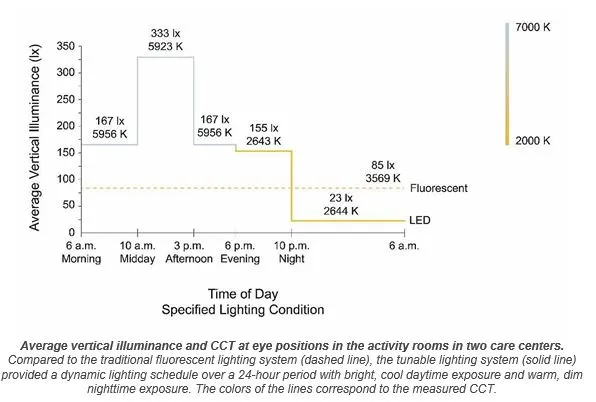
Overall, the LED retrofits resulted in more than a 60% reduction in lighting energy use, and greater energy savings were realized through a dimming schedule intended to support restful sleep. In the corridors and dining rooms, energy savings were even higher: 79% compared to the fluorescent systems. On-site lighting measurements verified the ability of the tunable lighting system to provide more light and higher correlated color temperature (CCT) during daytime hours and lower light levels and CCT in the evening hours, as shown in the figure below.
“The PNNL research into tunable lighting is invaluable as a resource for architects developing senior living facilities to provide environments that contribute to improved health and wellness of the residents,” said Scott Fitzgerald, associate principal at Perkins Eastman, an architecture firm with a large senior living practice that was not involved in this study. “Having research that validates the benefits of lighting tuned to circadian rhythms is critical to wider adoption of the technology in the healthcare and senior living practices.”
The energy saved from replacing fluorescent lighting with LED is clear and significant, as validated in this study. For senior care centers contemplating a retrofit, tunability is also worth considering because it enables adjustments to the luminous environment which are particularly important in creating contrast between daytime and nighttime light levels and CCT. Results of the study suggest that the cost-saving retrofit design strategies, careful technology selection, and automated lighting control strategies employed in these care centers not only provided substantial energy savings but also produced an easy-to-maintain, functional lighting system that effectively improved the quality of light and life for senior care residents.
Go HERE to download the full report