Report Assesses Market for Intelligent Lighting Controls in Commercial Buildings
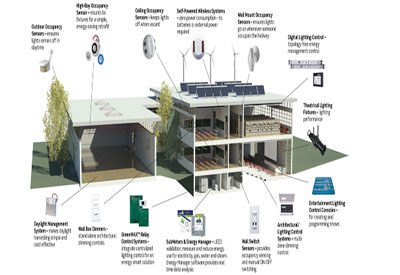
Revenue from the sale of global networked lighting controls revenue is expected to grow from US$2.2 billion in 2015 to US$4.8 billion in 2024, according to a Navigant Research report. The report provides a global market analysis and forecast for sensors, relays, switches, ballasts, drivers, controllers, and communications technologies for networked lighting controls.
In the midst of the ongoing transformation from fluorescent lighting to LED lighting, the market for lighting controls has expanded broadly. Expansion has occurred in terms of both the variety of control systems that are available and the number of systems that are being installed.
Building energy codes largely drive the adoption of more basic lighting controls such as occupancy sensors and photosensors. Yet, those codes also create the opportunity for a lighting project to upgrade to a more comprehensive control system for a modest price increase, says Navigant. To meet the growing demand for lighting control systems, different types of vendors have moved into the lighting controls market. Leading the innovative side of this move are pure-play start-up companies, which are largely responsible for the proliferation of creative ways to visualize lighting usage and devise new strategies to manage lighting energy consumption. The large, traditional lighting companies have begun offering a range of lighting control products, as well. Finally, the established building controls companies have also been expanding their capabilities to include lighting controls along with other buildingwide control systems.
The report’s global market forecasts for unit shipments and revenue, segmented by equipment type, building type, construction type, technology, and region, extend through 2024. The report details the market drivers for lighting controls technologies, including building codes, hardware costs, and consumer expectations, as well as barriers to adoption, and provides profiles of select industry players.
Find out more: https://www.navigantresearch.com/research/intelligent-lighting-controls-for-commercial-buildings