LEDs Optimized for Architectural and Emergency Vehicle Lighting Applications
May 10, 2017
As a mainstay in architectural and emergency vehicle lighting, colour LEDs bring about intrinsic advantages such as durability and reliability, in addition to the possibility of delivering controlled “colour light performances.” In recent years, however, the evolving architectural and emergency vehicle lighting landscape has necessitated developing colour LEDs that can enable the most effective and optimized system design.
Architectural lighting
In architectural lighting, a few design characteristics are of great importance. As the focus should be on the architecture that is being illuminated, the lighting fixtures should be invisible, and so the luminaire in turn needs to be very small.
To achieve a luminaire with as low of a profile as possible, the LEDs used should be able to work together with secondary optics to facilitate a small footprint system, allowing the highest flexibility with regards to where the luminaire can be mounted without being obtrusive to the observer. The smallest and most cost effective mounting options are also important. The size of the necessary secondary optics needed to achieve a desired light distribution is dependent on the beam shape and effective LED source size — namely, the virtual source size as it appears when the LED is encapsulated in its extraction optics.
While a colour LED with a small source size is key to achieving a small footprint system, there is a tradeoff with regard to extraction efficiency. One approach undertaken by Lumileds to address this involves custom designing the extraction optics of the LUXEON C Colour LED. Doing so ensures the ideal trade-off between a small source size (allowing for small and high performance secondary optics) and the highest possible extraction efficiency (which reduces the overall power budget and system cost).
Secondly, for architectural lighting, it is important to have design flexibility to allow the secondary optics design to work with any colour in the spectrum of available LED lamp colours. Traditionally, secondary optics designs varied depending on the colour scheme chosen by the lighting designer because the emission surface height is not consistent across different colours. The LUXEON C package was specifically designed such that the emitter surface height (distance between PCB and focal point of the secondary optics) is equivalent across all colours. This allows a secondary optics design that is independent of the proposed colour of the solution. For example, arrays of LEDs and a single, secondary optic can be customized so as to use the specific colour scheme chosen by the lighting designer for an individual building, without incurring the cost of redesign of the secondary optic and mould tool fabrication of specific colour schemes. Figure 1 shows RGB colour blending to white of LUXEON C (left column) and a competitive LED (right column). The top row of figures shows the range of CCTs within the field angle of the far field light distribution. LUXEON C (left) has 30% less variation in CCT over the field angle of the distribution than the competition (right).
Consistency in the focal height helps to minimize colour difference within the field angle of the light distribution, since a single height of the same optic is used for each colour. Similar emission patterns of individual colours eliminate high intensity regions (auras or halos) within the light distribution when combining colours. As seen in the bottom row of Figure 1, a competitive LED (right) exhibits a significant reddish aura compared to LUXEON C (left).
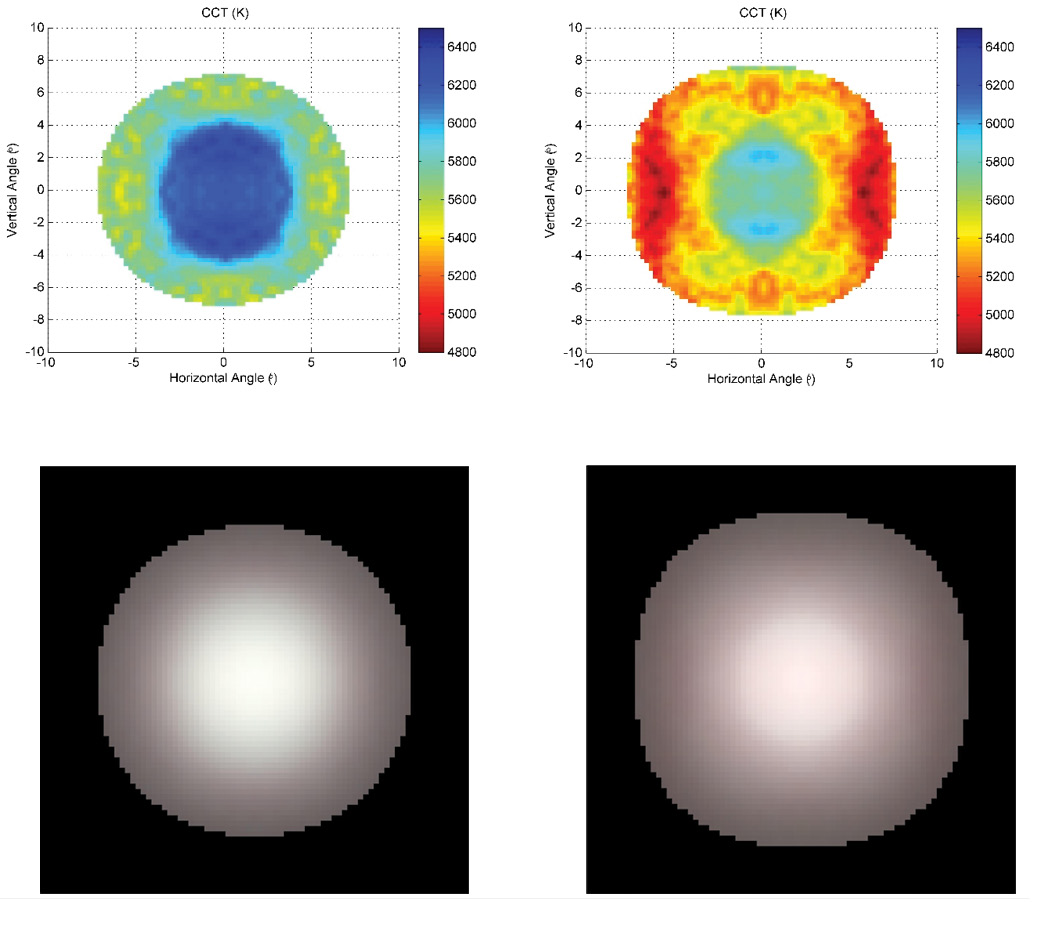
Figure 1. Colour blending of RGB to white with LUXEON C (left) and competition (right) for architectural applications.
LUXEON C has 30% less variation in CCT within the field angle of the light distribution compared with competition. Since every emitter has the same emitting height, a single optic can effectively blend all colours with identical mounting location, thus reducing colour difference and other unwanted features like auras and halos within the beam, as shown in the true colour renderings.
Furthermore, reliability is a pivotal aspect of LEDs for architectural lighting due to the fact that architectural installations are often very difficult and costly to replace. LUXEON C is designed around high thermal conductivity ceramic substrate, which allows low thermal resistivity for efficient board design. This feature enables driving at a lower Tj for enhanced reliability. Solder pad design is an industry standard 3 stripe design with 3 pads. An isolated thermal pad in the centre allows for low cost board design enabling FR-4 with thermal vias. The footprint is also compatible with attach to MCPCB by standard SMD tooling. Compared to the legacy colour LEDs in the industry, the LUXEON C Colour Line features an optically and mechanically symmetric package for simplified system design.
Emergency vehicle lighting
For emergency vehicle lighting (EVL), the constraints are as follows. A small footprint is necessary to allow for lighting fixtures to be designed and mounted without increasing aerodynamic drag on the vehicle. As EVL lights are added to the outside of a car, a slim form factor will help to reduce the additional wind resistance of the vehicle. A small form factor LED together with reflective and refractive lens designs will help to reduce the overall size of the fixture. A dense packing of linear or 2D arrays is possible since the footprint of the previous colour LUXEON Rebel has been reduced from about 14mm2 to 4mm2. Similar to architectural lighting, the primary extraction optics design is also very important for EVL. EVL signal light is sent out in a narrow cone angle to warn or signal other traffic participants, therefore lighting with a high “punch” is critical. The small source size of the LUXEON C Colour LED due to the custom extraction optics helps to reduce the size of the secondary optics. It will also enable a narrow focused beam with high punch for the smallest possible reflector or other secondary optics. Figure 2 shows the light distributions generated by using RGB LUXEON C, LUXEON Rebel, and competitive LEDs within the same small (25mm ø x 18mm) 8° FWHM TIR optics. For equal total emitter flux, LUXEON C shows a 40% improvement in centre beam candle power (CBCP) over LUXEON Rebel and a 16% improvement compared to competition.
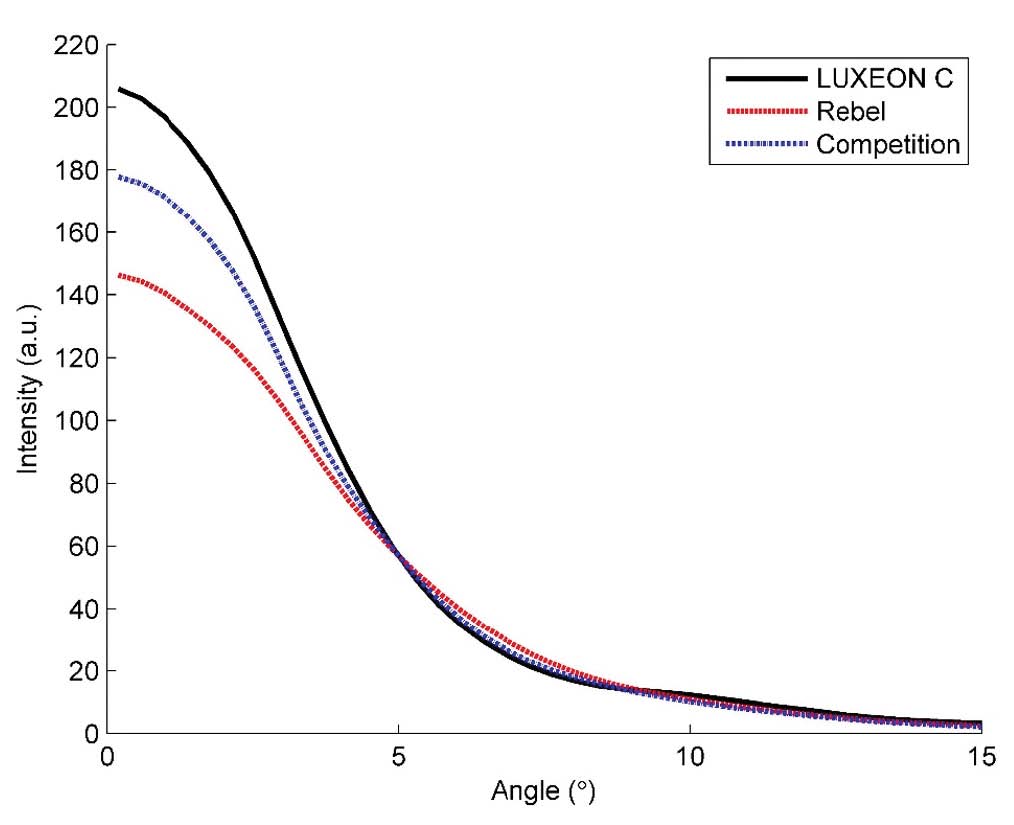 Figure 2. Light distributions of RGB LUXEON C, LUXEON Rebel, and Competitive LEDs using the same 8° secondary optic and total emitter flux. The centre beam candle power (CBCP) is superior for LUXEON C, demonstrating a 40% increase over LUXEON Rebel and 16% over competition.
Conclusion
For architectural lighting, LEDs must facilitate a luminaire that is small and doesn’t distract from the architecture at hand, promote design flexibility, reduce multiple secondary optics designs, and boost reliability due to the hard-to-reach nature of many architectural installations. Emergency vehicle lighting, on the other hand, requires a small footprint that doesn’t affect the aerodynamics of the vehicle while still delivering high punch. To address these concerns, Lumileds developed a line of colour LEDs, offered in a wide spectrum of colour, to facilitate optical and system design.