Shirley Coyle: Calm, Composed, and Fully Engaged
May 9, 2017
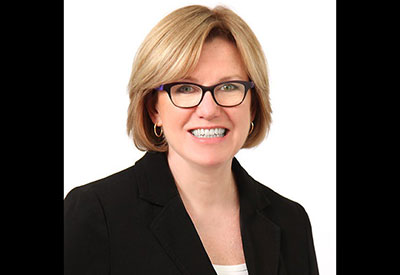
I met Shirley Coyle, President of Cree Canada and President of IESNA 2016-2017, when she was speaking at an IES Montreal Section meeting on March 21. The conference focused on the convergence of intelligent lighting systems with the Internet of things, and how this convergence would help improve the quality of our lives at work and at home, improve security, and increase the value of building systems. Her composure as we discussed such a complex topic reflects her extensive experience in the lighting industry and her involvement in IES and CSA committees.
Lighting Certified since 2000, Shirley is an active member of the Illuminating Engineering Society (IES), a Past President of the Toronto Section, past District Chair, and after five years on the IESNA Board of Directors, currently President of IES. She is a member of several IES committees including Roadway Lighting, and Street & Area Lighting. Shirley is also a member of CIE, and committee member for several CSA standards committees on lighting including Roadway and Solid State Lighting.
How did you choose a career in the lighting industry, and how has being a woman played a role in your career?
“My first full-time job out of university as a political science grad was for a lighting company in Toronto, where I was fortunate to have a good mentor who challenged me with lots of opportunities that enabled me to learn and take on new roles. So although I had not actively chosen the lighting industry, I quickly fell in love with it. There is so much to learn, and it has so much impact on spaces and the people within.
“Over the years I’ve worked for several lighting companies in Canada, where the smaller operation sizes gave me the chance to learn a lot of different roles — customer service, marketing, operations, finance and sales. And I realized that I liked being in a place where my role made a difference. What had interested me when I graduated from university was the business world. I thought I might go back to university to study business, but in the end I was able to learn the business world on the job as well as gaining lots of useful skills through my volunteer work with IES and CSA.
“As for being a woman, it’s probably been a barrier at times, and a benefit at other times. I find that if you know your stuff, most of the noise related to being a woman in a male-dominated industry goes away.
“My advice to other women: be well informed, be confidant while being open to new ideas, be willing to challenge the status quo. And while the industry can certainly do better, I must say that on the lighting side of the electrical industry there are more women in the lighting industry these days.
You’re very involved in the lighting industry and the standards. How important is this to you?
“The place of IES in my career has grown from being a local networking activity in the Toronto area, to national work in Canada, and from there to North America-wide. I’ve learned so much and met great people in Canada, the U.S. and Mexico.
“To outsiders, working with standards organizations may sound like watching paint dry, but within these activities there is a lot of good work, many laughs, lots of learning, and lifetime connections to great people — resources in your working life and personal life. You meet researchers, colleagues… and you realize that you always have so much more to learn. The conferences and technical meetings provide great opportunities to learn and share information.
“I’m happy to be in this industry because it is at the heart of the current changes in the technology. Ten years ago LED technology changed everything. Now, it’s research about the non-visual effects of lighting that is at the heart of real change. Lighting can be a very positive force.”
What have been the biggest challenges in your career and what are those in front of you?
“The biggest has been to assemble the right team. Also managing through the inevitable ups and downs of business cycles.
“As for challenges ahead: integrating lighting and health-related research results into what we do. How can we balance the rapid pace of technological change with an ongoing flow of new research on the non-visual applications of light? For instance, light as a non-pharmacological tool.”
Which decisions do you find the most difficult to make?
“I find that that decisions around hiring or terminating team members are always the most difficult, but it’s a responsibility that comes with managing people and businesses. Getting the right fit is critical, and addressing problems is essential to keeping the whole team engaged and performing well.”
Which emerging technologies do you think will have the greatest impact on our industry in the near future?
“Connected (PoE) lighting — lighting as an integrated building system. We need to make sure that we are ready to face the new challenges. IT is becoming more critical, and if we are not involved in the conversation, the lighting quality could be more of a footnote. Our role in the lighting community is to ensure lighting quality is part of the equation as lighting becomes an integrated building system carrying sensors that will do a lot of non-lighting functions “The other impact will be lighting for non-visual effects — ‘circadian’ lighting and colour tuning. We have to understand it as an industry and as individuals. We should not oversimplify the debate to blue light, or the AMA recommendation on 3000K.* Lighting is so critical in every aspect of our lives, and we need to do more to make the benefits better understood to the general public.”
If you could change one thing about our industry, what would it be?
“Get us to turn our attention outward and be more forward looking. We tend to talk among ourselves a lot in the lighting and electrical industry. In lighting, we haven’t done a good job of getting the public to understand the value and impact of good lighting quality. Even our families have little idea what we do.”
How did you become President of IES?
“I started when I realized the importance of standards and someone suggested I get involved in IES. After a lot of years at the local IES section and involvement on national committees, I was fortunate to get the opportunity to participate on the Board. I had business experience and a useful skill set — getting people to find consensus; I was also very fortunate that my employer, Cree, Inc. supported me in the significant time commitment for this role.”
What do employees get from being part of a network like IES?
“A valuable network of contacts, technical knowledge, professional skills, skills to work out consensus… All things that will make them more valuable and effective employees and leaders in their workplaces.”
You mentioned quality of lighting five times during our conversation. I would say it seems very important to you.
“It is IES’s mission and role to consider the quality of lighting, not in terms of the number of lumens, but the overall impact on the space. We all want better design with the best possible performance and the best quality of light.”
How do you separate work from family and personal life?
“I’m not always successful at it, but I try to focus on where I am and to be “present and engaged,” either at home or at work. My kids are young adults, so it’s easier for me now, and I am fortunate to have a partner who was our family anchor at home when our kids were young and I was away a lot. He made it possible for me to do my work and volunteer travel.”
Your source of inspiration in life and business?
“Mentors, including my late father, who was GM of Quality Control at Heinz Canada, as well as the many interesting people I’ve met over the years. While the travel itself gets old fast, I still feel it’s a gift to be able to travel to many places, meet people, and learn about their lives and their communities.
“My other great sources of inspiration are music, reading, spending time at a little cabin we have now north of Kingston on a small lake. Nothing beats a morning reading, with a fire in the woodstove, looking out on the lake.”
* Read Shirley’s response to the AMA’s position on blue light in the previous issue of LDS.
Line Goyette is Managing Editor of LDS; linegoyette@kerrwil.com.