DLC Proposes Changes to Technical Requirements for SSL Categories
August 8, 2016
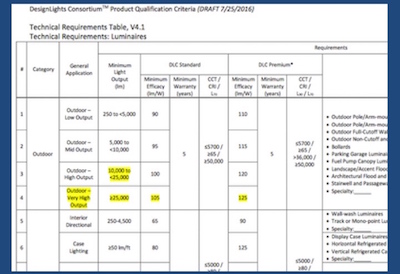
The DesignLights Consortium has released for comment several new and revised technical requirements for categories of solid-state lighting (SSL) products that are proposed to be added to the Technical Requirements as Table V4.1.
Deadline for comments: September 7, 2016. The draft V4.1 proposal includes the following expansions and revisions.
Very high-output outdoor lighting
DLC is proposing to create an additional category for outdoor SSL products ≥25,000 lumens, with an associated increase in efficacy requirements. As has been discussed previously during the specification development effort in 2013, and in the development of the V3.0 requirements in 2014-15, savings claims for member energy efficiency programs are dependent not only on the performance of the SSL product in question, but also on the performance of the incumbent technology that constitutes the “baseline” for any given application. In outdoor lighting, these baselines are most often tied to the performance of HID products.
Although there is an understanding that, owing to factors such as improved lighting design and improved optical control, LED products do not necessarily need to replace HID products lumen-for-lumen, it is generally expected that higher light output LED products are more likely to replace higher light output (and wattage) HID products. Because higher wattage HID lamps are more efficacious, the DLC requirements for higher lumen LED products must be higher to ensure members are still able to achieve meaningful savings.
While in previous development rounds members have indicated that given the activity in their markets, a “high” output level of ≥10,000 lumens was sufficient for a top “bin”, DLC has received increasing requests for a “very high” bin, as LED products continue to be developed that can replace even higher wattage HID lamps. Hence, DLC’s proposal to create an additional category for outdoor SSL products ≥25,000 lumens.
U-bend replacement lamps
DLC proposes to include standard U-bend replacement products as eligible for DLC. These products have sufficient volume and impact in member programs that there is interest from members in DLC adding this category to the QPL.
Additional considerations regarding linear replacement lamps (TLEDs)
In addition to proposing to add U-bend replacement lamps, DLC is considering revising the existing TLED category definitions and testing policies to clearly delineate these categories as intended to cover replacements for G13-base, T8 lamps. Member programs have indicated that incentives structured around G5-base, T5 and T5HO replacement lamps would necessarily be different from those for T8 replacement lamps, and therefore a single category allowing space for both lamp types is unhelpful. Feedback is welcome on the impact of isolating the existing categories to explicitly and exclusively cover replacements for T8 lamps. Other replacement lamp types (including 3-, 5-, 6-, and 8-foot linear products, and specific categories addressing T5 and T5HO replacements) remain under consideration, but are not proposed to be included at this time. These additional categories may or may not be developed in future development cycles depending on the priority and need of the DLC member programs.
Refrigerator case lighting definition revision
Current DLC policy includes a restriction against refrigerator case lighting products that employ standard pin bases to connect to the refrigerator case. The intention of this restriction is, in large part, to limit the possibility of unsophisticated TLED replacement lamps seeking to qualify in the refrigerator case lighting categories as a “loophole.” There have been products proposed for qualification to the DLC that include pin-type electrical connections, but which do not employ these connections as a standard “base” for a lamp, rather using them only for electrical connectivity.
In consultation with the DLC membership, DLC is proposing a clarification to the current definitions for the refrigerator case lighting categories that would clarify the eligibility status of these products. The language proposed would allow products that employ pin-type connections for electrical purposes only — but which do not provide mechanical support — to qualify.
Hazardous environment lighting definition and requirements
With the inclusion of “Specialty” provisions under the V3.0 restructure of the technical requirements, DLC has seen an increase in the number of products seeking to describe themselves in their DLC listing as “Hazardous” environment lighting of various types. There is concern from DLC and the membership that manufacturers may be using this DLC descriptor term as a marketing tool, but currently there are no explicit rules or restrictions for what a product must demonstrate in order to be described as “hazardous.”
To address this issue, DLC intends to develop rules and requirements for products that seek to be described as “hazardous” on the QPL. At this time, DLC seeks comment from knowledgeable stakeholders regarding appropriate requirements that determine whether products should be able to describe themselves as for use in “hazardous” locations. Requested comments include both what features, certifications, or other requirements products must have, and what DLC documentation requirements should be for verifying those features or ratings. Early suggestions have included specific safety certifications, IP ratings, or class and division ratings related to the National Electrical Code and/or Canadian Electrical Code.
This effort to define performance and features of fixture for use in hazardous locations may lead into proposals for allowances under the new provisions of the V4.0 Technical Requirements. As with the initial solicitation regarding allowances, if stakeholders believe that specific ratings or features require an allowance to practically accommodate, specific proposals are requested on how to define those features, why they require an allowance, and what those allowances should be.
See the proposed changes here: https://designlights.org/resources/file/TRT_V41_Draft_FULLTABLE_highlights_Final.
Submit comments on any of the above in writing to info@designlights.org. If you have any questions, please direct them to info@designlights.org.