The Road Behind Us Was Lit with a Different Light, Part 1

August 6, 2018
Like most historical records we are left with two primary methods to understand the past. The first being written accounts by those who were present; the second, the historical record, which can support written accounts and be used to piece together an image of the past through careful analysis. When looking back at the introduction of electric lighting in Canada we have both sources to draw upon.
The written accounts are varied and easily accessible, but the material record is often more difficult to fully understand. We are fortunate that much of the work regarding the material record has been completed by Parks Canada, which also houses much of the material record and has made information on it publicly accessible in an article titled Lighting Devices in the National Reference Collections, Parks Canada.[1]
To begin need to point out some historical facts that were the driving force for the complete adoption of electric lighting, which largely saw its genesis in the form of street lighting. Electricity first became available for street lighting at the end of the 19th century particularly in countries with a high level of industrialization such as England and the US. In Canada electric street lighting surged into place over the last two decades of the 19th century and early 20th century. Looking back this makes sense as it coincides with the first hydroelectric plants, and the early days of power distribution.[2]
Summary reports from the time have been maintained, and an early record shows that “the number of electric lighting companies (in Canada) increased from 259 in 1898 and 306 in 1901 to 312 in 1902.” The biggest advances were primarily made in Ontario and Quebec where electricity was adopted to power lighting and motors by large mining companies and the pulp and paper industry. The adoption here was also helped along by the ability to have multiple power generation stations along the St. Lawrence river. However, Canada continued to experiment and advance its energy generation methods.
“By that date (1925) electricity supplied well over twice as much as the above sources (hydraulic turbines, water wheels), whereas in 1911 water supplied two and a half times as much mechanical power as electricity. In Ontario and Quebec, imported coal furnished in 1943 over 50% of the total energy consumes.”
This demonstrates that electric lighting of streets and homes was closely linked with industry. Because of this the early lighting of streets, public places and homes was geographically tied to industrialized areas, which in at least some cases explain the slow adoption of electricity in cities and the countryside over the first half of the century.
And now to consider the primary sources of lighting that were introduced along with the adoption and expansion of the electrical network. Although there was a fairly wide variety of lighting methods that were being developed at the time it was initially the incandescent lamp and the arc lamp that gained widespread use. The incandescent lamp, on account of its simplicity and relatively low cost, was the primary source of lighting used in industrial and domestic life through the early decades of the 20th century.
The incandescent lamp was not perfect and underwent substantial technological advances as inventors continually struggled with increasing the brightness of the luminous flux produced by the filament while simultaneously attempting to lengthen the life of the bulb.
The incandescent lamp, which had its begins in 1840, was quite rudimentary at first and continued to be modified by various scientists, including Edison, who patented the Edison lamp around the end of 1879. One of the most notable advances made by Edison occurred in 1881, when the lamp was equipped with something truly that revolutionized that paved the way for mass production: the screw base.
Another major development, and the beginning of the modern incandescent lamp, came in 1907 when commercial production of tungsten filaments began in the U.S. The advancement significantly increased the life of the lamp and although it continued to evolve the general structure and operation of the incandescent bulb had been solidified.
Going beyond the primary lighting for industry and domestic use was the arc lamp, the main source of lighting for streets and public spaces. The arc lamp has a fairly basic design concept that has two graphite electrodes held in place by conductors connected to a source that supplies the necessary current to operate the lamp. However simple in concept, in reality the lamps were complex machines. “Nearly all include a system for regulating the resistance voltage to control the intensity of the current circulating through the lamp, and a solenoid which ensures the correct spacing between electrodes both when the lamp is lit and when the electrodes are consumed.”[3]
The electric arc that was created gave off much more light than the incandescent bulb, but it tended to be an intense and harsh light that also produced a substantial amount of heat, odour, smoke, and noise, and often twinkled. Because of these factors, few arc lamps were developed for use in buildings, although the archaeological record does show some miniaturized modules were developed.
The arc lamp underwent substantial technical improvements from the late 19th and into the early 20th century, which are not easy to follow and do not show up in the archaeological record. Unfortunately, many of the lamps were either repaired or parted out so tracking their progression or even finding a complete original is rare.
The arc lamp remained in production for use in outdoor lighting until the 1950s, when it was phased out in favour of high-intensity incandescent lamps that required less maintenance and allowed for far more standardization.
In Part 2: further advances made to the incandescent bulb and ultimately its replacement by the rapid rise of LED technology.
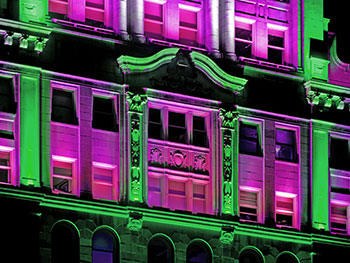
Photo source: Schuetz-Medien Design, Pixabay
Notes
- E.I Woodhead, C. Sullivan, and G. Gusset. “Lighting Devices in the National Reference Collection, Parks Canada,” Studies in Archaeology, Architecture and History, 1984
- Ibid, p. 68
- Ibid, p. 74
Owen Hurst is Managing Editor of LDS’s sister publication, Panel Builder & Systems Integrator: http://panelbuildersystemsintegrator.ca