Shedding Some Light on Commercial and Industrial LED Applications: Part 2
Dec 8, 2020
By Lynn Belken and Katy McSurdy
In Part 1 of this interview with Leora Radetsky, we covered smart lighting, customizability, and COVID-19 possibilities. For Part 2 we are diving into indoor agriculture, how utilities are helping drive LED adoption with incentives, and challenges in the LED market.
KM: What can you tell us about indoor agriculture and LEDs?
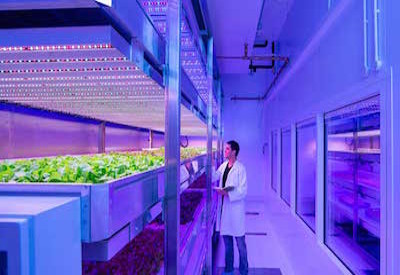
LR: This is an area I am very excited about. We’re seeing more and more square footage devoted to growing products indoors. One of the most important things to realize about CEA is that the light levels needed for plants are much higher than the light levels for people — 10 or even 100 times higher. With those higher light levels, you have concern from growers, utilities, EE programs, and states about how much energy is being used.
LED products provide not only the ability to save more energy than incumbent systems, but also a different choice of light spectra so that growers can optimize their plant growth and products. For some products, using a certain spectrum (colour) of LED can improve the growth cycle and shorten the growing time. A shorter growing time results in more crops on the market and an increased profit. Light for plants is food and nutrients. If you dim the light source to save on energy, you can harm the plants and the grower’s profit.
LEDs can also last longer than HPS and metal halide light sources, which equals improved maintenance costs and operational costs for growers because they are replacing less often. Now we are seeing LED products that can produce more light than the best performing HPS. So if you have crops that need a lot of light (like cannabis), not only can you replace LED for HPS on a 1:1 basis, you may be able to have 1 LED for 2 HPS fixtures. Saving growers even more money.
One of the benefits of LEDs is the way they produce heat. Yes, they still produce heat, but they are more energy efficient so they are not producing as much heat and because they are not directly radiating the crop, they are not damaging them with too much heat. In many cases, you can even put the LEDs closer to the crop canopy, which means you can have a lower wattage light (saving growers energy), but still provide the same amount of light to the crops. There are a lot of regulations popping up for CEA related to maximum lighting power density or minimum efficacy. Even though the maximum lighting power density is much higher for CEA than commercial lighting, it is oftentimes still not enough light for some crops. That’s where LEDs can help — they are more efficacious and growers can pick the light level that they need to be profitable.
KM: Are farmers finding that indoor agriculture is more profitable?
If you can grow in a greenhouse and you have a lot of daylight in the greenhouse, it is more profitable because you can use natural light. But part of what farmers get in a greenhouse is affected by the glazing on the glass. The glazing used on the glass might cut off UV light and some cases the UV light is beneficial for plants and they won’t get that because of the glass. Glass also lets in heat and the farmer then needs to vent/open up the greenhouse to control the heat. The effect of too much heat is that it can dry out the plants, dry out the soil, you have to water more, etc. It comes down to balance.
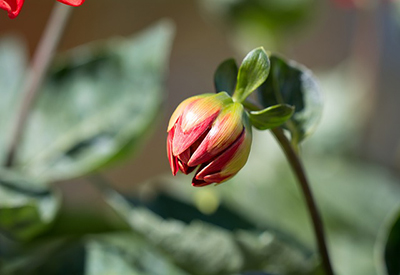
But what is interesting about lighting and plants grown in indoor facilities, is that the plants currently being grown in greenhouses/indoor facilities have developed under sunlight, which is a very broad type of light. There are some initiatives happening to develop different strains of plants/cultivars (like lettuce) that are developed to be more effective at growing under LEDs. Just like developing other cultivars — sweet smelling roses, roses with multiple blooms — genetics are helping us grow crops more effectively indoors. Genetics of the plants is key, we have more people on the planet, we have climate change which is making it harder to grow crops outdoors. There’s catastrophic flooding and drought events, pests that are adapting to weather changes, and diseases that are becoming resistant to chemicals that are used. If we can look at lighting and genetics together, I think that’s the way we are going to grow the food we need for people.
KM: What role have utilities and energy programs played in the adoption of LEDs?
LR: They’ve played a really large role in market transformation. First and foremost, the incentives they provide buy down the cost and help make the products more affordable. They also help prove the products are viable — if they use an Energy Star threshold or DLC specification, they are setting a threshold for minimum product performance. Incentives help to drive baselines higher so that LED technology becomes the norm. By focusing on quality as well as cost and energy savings, the lighting will meet the customer’s expectations. There are a lot of products in the market, so taking a little care up front will go a long way to satisfaction.
KM: In residential applications, consumers have concerns about choosing the right brand, dimming features, etc. Do C&I customers have these same concerns? What should they do about buzzing or humming from LEDs in that setting?
LR: There is still some of that concern, especially in retrofit vs. new construction. You want to make sure that you don’t have compatibility issues; most of these concerns have to do with interoperability (i.e. is the dimmer compatible with the light source and is the light source compatible with the dimmer?). Look at spec sheets and talk to the manufacturer to ensure compatibility is important. If you have a product that is specified and another product is substituted due to cost during the bidding process, you could end up with compatibility issues that haven’t been addressed. Make sure that specifications are mentioned and look at requirements for dimming and other compatibility features. In commercial lighting there is a different value chain with many more choices of controls and lighting and support from representatives and distributors, since you are not just shopping at a big box or hardware store. Buzzing and humming can be a sign of a compatibility problem between the control system and the luminaire. Or, it might be from the controller/hub; and in those cases you need to remote that hub or peripheral components to make sure they are not audible to occupants.
KM: What are some of the challenges that LEDs have been facing in the market?
LR: The accuracy of lifetime claims is important. LEDs can last a long time, but if they are no longer producing enough light or if the colour is shifting, that is a problem for people. Even though they are not failing immediately, they may last a long time but that is not always good enough. As an industry we need to understand this better and understand when it is time to replace. Serviceability is starting to be addressed, but there is room to improve. What components are serviceable? How easy is it to service/swap parts? Do you have enough information to buy a new one to match if you need a certain colour? Or do you replace all, so that the products match? Along with that, comes sustainability — how can we recycle and produce sustainable products over a long period of time so that we are not producing a lot of waste stream products?
KM: Anything else you feel is important that we share?
LR: I don’t think that you can have a silver bullet or one product that will be best for every application. I really think that people should do their due diligence by validating performance claims and warranty language, and verifying the service that the manufacturer and installer offer. Lighting is a long-term investment — you want to pick a good product. Lighting design professionals are helpful and important to help customers find good quality products, and to help customers understand the limitations and characteristics of those products. In the end the customer needs to be comfortable with the investment, so it’s important to validate the claims and know what you are buying.
KM: Thanks so much for a fascinating interview on LEDs. I learned a ton! I had no idea customizable lighting was within reach and that plant cultivars are being created around LEDs. I’m excited and hopeful for the future of lighting and energy efficiency. Thanks for sharing your time with us.
To learn more about LEDs, check out Part 1 of this interview.
Lynn Belken is A Senior Marketing Account Representative for Nexant. Katy McSurdy is a Content Marketing Strategist, also with Nexant. This article was first published as a Nexant blog.
Photo source: Philips Lighting