DesignLights Consortium Releases Final Technical Requirements Table V4.0
Design Lights Consortium


June 05 2016

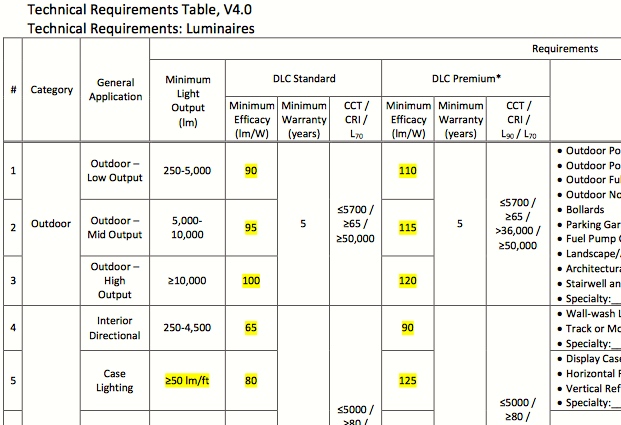
The just-released 4.0 version revises efficacy requirements in an effort to keep pace with changes in the market and support the energy savings goals and other needs of DLC members. 

Previous revisions that were finalized in 2014 and 2015 focused primarily on restructuring the technical requirements table, establishing requirements for the DLC Premium classification, enabling a pathway for products to be qualified under new Specialty Use designations, and adding categories to the Technical Requirements Table. The last major revision to efficacy levels for the DLC Standard classification was announced in April 2013, and took effect on January 1, 2014.

The solid-state lighting market has grown and product performance has improved significantly in the nearly three years since the V2.0 efficacy levels were established. To keep up with these performance improvements, the V4.0 revision focuses primarily on efficacy. While each DLC member efficiency program operates independently and have its own specific needs, this amount of revision is necessary for most programs to be able to differentiate product performance to continue offering incentives for DLC qualified products.

With the change in standard requirements, as well as product development and evolution in efficiency programs, the DLC has raised the requirements for Premium as well to serve the needs of its membership. The objective for the Premium classification is to identify the top 5-10% most efficacious products in any given category.

Among the changes, the V4.0 Technical Requirements document includes a placeholder for a new Table 6, identifying “Allowances” for specific product types. In the feedback received from stakeholders regarding the draft proposals released for comment in February, significant commentary discussed certain features of specific products that related to quality, but that made meeting the proposed efficacy levels more difficult to achieve relative to products without those features.

Find out more about the changes: https://www.designlights.org/resources/file/TRT_V40_Final_Cover_Letter_6-1-16_Final.
 

Related Articles


Changing Scene


Design

  • Omnify: 7 Common Light Panel Mistakes (And How to Fix Them)

    Omnify: 7 Common Light Panel Mistakes (And How to Fix Them)

    You’ve invested in premium LED light guide panels for your retail display or commercial project. The specs looked perfect. The samples were gorgeous. But now? Something’s off. Maybe the lighting is uneven, or panels are starting to fail way before they should. Here’s the thing, most LED light guide panel problems aren’t manufacturing defects. They’re… Read More…

  • Legrand: The Benefits of DMX Lighting in Modern Commercial Spaces 

    Legrand: The Benefits of DMX Lighting in Modern Commercial Spaces 

    DMX lighting is a powerful control protocol originally developed for theaters and entertainment venues, but its reach has expanded far beyond the stage. Today, DMX is increasingly used in commercial, educational, healthcare, and architectural environments to create dynamic, color-rich, and adaptable lighting experiences. Where traditional lighting systems focus primarily on on/off and dimming control, DMX… Read More…


New Products

  • RENO Lighting: Aerolux – Adaptive Area Light with Field-Adjustable Distribution

    RENO Lighting: Aerolux – Adaptive Area Light with Field-Adjustable Distribution

    Meet the Aerolux Series—a sculpted area light with on-site adjustable distribution, delivering precise, adaptable illumination across a range of applications. With a slim, curved profile and durable die-cast aluminum construction, Aerolux combines refined design with lasting performance and durability. One fixture. Multiple configurations. No compromises. Aerolux reduces SKU complexity while increasing on-site flexibility, and is… Read More…

  • LEDVANCE: SYLVANIA TruWave Technology

    LEDVANCE: SYLVANIA TruWave Technology

    TruWave Technology is a lighting technology developed by SYLVANIA. It provides the closest possible lighting experience to natural light by mimicking the natural light spectrum. Natural light is the most common light source in daily life, and it helps regulate body clocks and improve mood and focus. However, in indoor environments, the amount of natural… Read More…