A Business Case for Future-proofing Building Lighting Systems, Part 1
March 25, 2018
The economic impetus to convert traditional incandescent and fluorescent lighting to digital LED is rapidly becoming inescapable. With proven energy saving rates of 60% and beyond, the return on investment is hard to beat among capital improvement projects.
Facility managers are constantly pressed with the cost of energy per square foot, as well as the overall operational cost per square foot. While LED retrofit is becoming increasingly more palatable, building owners and operators are still limiting projects to the fundamental, must-do upgrades, with the mindset of containing costs at every turn. This may be a safe short-term return strategy, but in doing so, they are foregoing the opportunity for low-cost future enhancements that can drive value.
The rationale for this argument is that lighting is not only a major consumer of a building’s energy, it is an integral part of the overall building management system (BMS) infrastructure — arguably the most pervasive system in the building.
Today’s smart LED lighting and controls systems can be networked and outfitted with sensor arrays. They can be integrated with other systems such as HVAC and security, and provide real-time area and environmental data. As such, the lighting system can play a much larger role in managing a building’s environment and in enabling new building functionality.
Everywhere there are people, there are lights, indoor and outdoor, creating a consistent grid placement and a sensory network, and making them ideal to deploy additional embedded technologies and applications for building owners, managers and occupants that deliver on the promise of the Internet of Things.
With this idea in mind, building owners and managers embarking on an LED lighting installation or retrofit should take advantage of the opportunity to future-proof their building management infrastructure by investing today in systems that can be upgraded efficiently and cost effectively as the need or desire for new functionality emerges.
Unfortunately, many “actors” in the BMS process chain do not understand the value of future-proofing or what it really means to future-proof a building system. The real business case hasn’t been well articulated. Owners and managers are not willing to take a longer look at the investment. As such, investments are minimized and future- proofing projects are incomplete or inadequate.
This business case lays out a rationale for future-proofing buildings and provides tools that will enable building owners to think more strategically about how they are looking at their building management systems and make initial investments upfront for long-term benefit.
- Why future-proof and why do it now
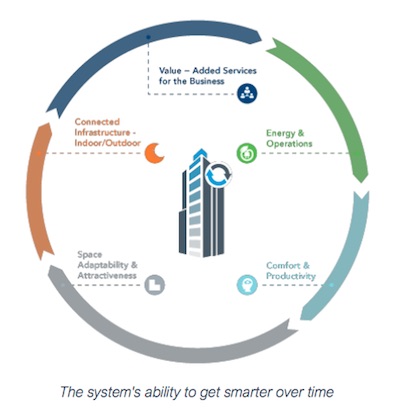
Future-proofing a lighting system is essentially making a strategic investment in the system’s ability to get smarter over time, versus one that has finite functionality and will ultimately become obsolete. There is a devilishly simple argument for future-proofing lighting and controls systems at the time of installation or retrofit:
- Building owners are going to invest in LED retrofit one way or the other — the energy savings benefit is too compelling.
- The LED investment is going to include some level of lighting control. The upcharge to future-proof adds to the project cost, but not upgrading means having to retrofit again when new services or capabilities are required which will be an even greater cost.
- Investing in a smart lighting system that can be upgraded easily and cost effectively via software represents a minimal incremental investment that will significantly reduce the cost of adding functionality in the future.
- Investing in lighting and overall BMS controls that are not only networkable, but IP-based, lay the foundation for efficient exchange of data — within your BMS but also with your enterprise applications, cloud applications and third-party systems.
As such, once the decision to move forward on a retrofit is made, the question should be where the building system functionality will need to be in the future. This will enable you to choose a scalable and distributed infrastructure that allows for numerous enhancements at a fraction of the cost of a full system upgrade.
It used to be sufficient to have one thermostat and no controls in a building space. Today, facilities managers are zoning the lighting, HVAC and other building utilities differently for more efficiency. As energy costs rise, building owners will want a more flexible and zoned system in the building to enable more precise control. It’s the difference between using a scalpel and a sword. Zoning precision allows owners to keep people comfortable and productive, while being granular enough to reduce or turn off lighting and other BMS functions based on real-time conditions — from building and smart grid energy conditions, to precise occupancy status. Future-proofing enables heightened precision in conditions, and the continuous exchange of that data makes BMS smarter in metering consumption and more responsive to demands.
In the figure below: future building requirements requiring investment in future-proofing.
- Dynamic reconfiguring of office space
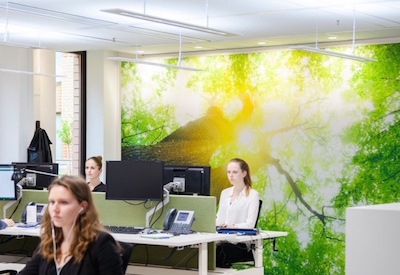
Employees are getting more sporadic in their working hours and they are working more in collaborative teams. As such, spaces need to be more dynamic. Building spaces such as offices, classrooms, warehouses or factories will inevitably require reconfiguring based on new tenant needs, new modes of collaboration and other changes in the purpose and function of the space.
For example, with an increasingly mobile workforce, the number of private offices and cubicles is decreasing. Office developers now expect to have some portion of an office floor plan leased out with micro leases because the new incubator and start-up tenants cannot commit to a full five-year lease. And there is a growing trend in concierge workplace services in which workspace can be configured to the specific requirements or personal choices of the employee.
Shifts in the working environment from assembly lines, to classrooms and desks are moving from individual to group and team activities. Even furniture — desks and chairs — are on wheels and that requires re-configurability. Warehouses are moving toward a highly automated environment, with robots working certain paths on production lines. In addition, schools and universities are creating increasingly connective learning environments. As classrooms are being updated with smart white boards and other connected tools, smarter lighting systems can support future ways of learning and future ways of interacting with the space.
In the industrial space, there’s a growing number of facilities that will be fully automated or have “lights out” conditions because robots are doing a lot of the work. Which may seem contrary to a future-proofed lighting argument, but from the standpoint of service stability and efficiency, the lighting network with the right kind of technology embedded in it can become a constellation of sensors and inputs that could potentially support automation. Flexibility, even in industrial lighting, can be part of a future-proofing strategy.
- Building functionality driving organizational performance
Beyond energy efficiency and cost reduction metrics, there is value in how systems help drive overall performance goals, be it employee productivity, student test scores or patient outcomes. Intelligent building technologies can produce organizational productivity gains in addition to energy savings.
A recent building management report from Jones Lang LaSallei[1] suggests that there is a “3-30-300” rule of thumb that organizations typically spend approximately $3 per square foot, per year for utilities, $30 for rent and $300 for payroll. While these figures are just archetypes, they are useful in providing an order of magnitude between the three areas of expenditure.
According to the 3-30-300 model, the greatest financial savings from greening a workplace may not be in energy but in productivity.
A 2% energy efficiency improvement would result in savings of $.06 per square foot, but a 2% improvement in productivity would result in $6 per square foot through increased employee performance. As beneficial as energy savings can be, any green investment that increases employee wellness and productivity can have exponentially greater value.
Research by the Canadian Automated Building Association (CABA)[2] also suggests that people cost more than buildings and BMS, so incremental improvements in human productivity eclipse energy savings and other cost efficiencies. CABA has undertaken a project to create a validated framework to estimate the economic benefit of investments in smart building technologies. In addition, CABA has developed a scorecard that enables decision makers to benchmark their buildings against others on multiple organization productivity metrics, as well as evaluates the benefits of building choices.
Research is also being conducted to quantify the effect of personalized dimming controls at the workstation on both energy savings and occupant benefits. Non-conventional approaches to lighting a space, such as tunable light, have also been shown to improve occupant experience. While the benefits of colour changing are just beginning to become evident, a minor investment today can ensure considerable flexibility later.
- Data collection, analytics and insights
Once a building converts to digital lighting using an intelligent platform of smart luminaires and networked controllers, the system produces a constant flow of data. Typically, data are captured by way of sensors embedded into the light fixtures and controls systems. The data can include lux level, temperature, humidity and occupancy, all of which can be translated into valuable, actionable information on energy use, space occupancy, occupant pathing and space utilization that can be analyzed and visualized to help drive better building performance and behaviours. The data can also connect to business intelligence and ERP system such as utilities and tenant billing, and HR systems.
A future-proofed smart lighting system can support building-level systems monitoring, and dashboards such as energy monitors that allow performance improvements over time. Facility managers can become more proactive and accountable for performance by establishing benchmarks and measuring energy usage before and after they put some energy initiatives in place.
In Part 2: common misconceptions about future-proofing, and what to consider before you start the process. Watch for it in the next issue of LDS.
This article was first published online by Acuity Brands. Read the full article: https://cdn2.hubspot.net/hubfs/2327376/AC_6941_Smart Building Whitepaper Gated Content Campaign_0917/Whitepaper_FutureProofing.pdf.
Notes
- Source: http://www.us.jll.com/united-states/en-us/Documents/green%20productive%20workplace%20overview_JLL_april2014.pdfus/Documents/green%20productive%20workplace%20overview_JLL_april2014.pdf
- Source: CABA: Improving Organizational Productivity with Building Automation Systems CABA – IIBC Webinar
10 July 2015