Daylight Management Opens the Window to Comfort and Energy Efficiency
May 9, 2017
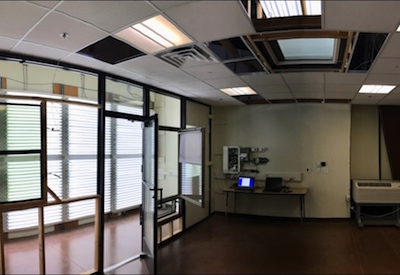
Daylight management is an emerging term referring to strategies and technologies for controlling daylight penetration in interior spaces through windows, clerestories, skylights, tubular daylighting devices, and building core sun-lighting systems to maximize daylight benefits. This article presents key performance aspects affected by daylight penetration in interior spaces, along with strategies and technologies used to effectively manage its dispersion to address the daily and seasonal changes in outdoor and indoor conditions. Shown in photo: CLTC Daylight Harvesting Optimization laboratory.*
Daylight benefits
The daily and seasonal variation of solar radiation has shaped life on earth over millions of years. Our vision and circadian rhythms have been shaped by the variations of the spectral power distribution and intensity of daylight. As we increasingly spend more time indoors during daytime, it is important to bring daylight indoors to satisfy significant psychological andbiological needs.
The most important psychological benefit of daylight penetration in interior spaces is the information it provides about outdoor conditions, such as the time of day, weather conditions, and the state of our surrounding world. Windows provide the most informative view and thus the greatest psychological benefits. Clerestories and skylights also provide some connection to the outdoors, especially when they provide view of the sky. Tubular daylighting devices and building core sun-lighting systems, which are designed to transfer daylight and sunlight deep into building core spaces, do not provide view but still provide some information about time of day and weather conditions.
The most important biological benefits of daylight penetration in interior spaces are related to vision and circadian rhythms. Daylight is an excellent source of illumination for visual activities and has been a common standard for the evaluation of colour rendering fidelity of electric lighting sources. The circadian benefits were discovered about 15 years ago, through the realization of the function of certain ganglion cells in the retina, referred to as ipRGCs (intrinsically photosensitive retinal ganglion cells). With peak sensitivity in the blue part of the visible spectrum, ipRGCs send messages to our brains that adjust our biological clock to maintain healthy circadian rhythms, i.e., excretion of hormones that strongly affect our sleep-wake patterns, body temperature, metabolic activity, alertness, etc., all of which are critical for health and wellbeing.
A third important benefit of daylight is its potential contribution to sustainability through energy efficiency. Using daylight to satisfy interior illumination needs reduces electric lighting loads. The term “daylight harvesting” initially referred to the practice of saving electric lighting energy in commercial spaces by adjusting the output of electric lighting systems based on interior daylight levels. Various strategies and technologies have emerged over the past several decades, continually improving reliability in determining interior daylight levels through use of photo sensors. Moreover, controlling electric lighting through switching and dimming has now been mostly resolved with solid-state lighting. Traditionally, daylight management at the window level is provided mostly for luminous comfort, view and privacy, through use of window attachments such as Venetian blinds, vertical louvers, roll down shades, and screens, controlled manually by occupants.
Daylight challenges and opportunities
While daylight offers significant benefits, it can also produce uncomfortable conditions. Direct solar exposure can produce discomfort through glare and heat, especially during the cooling season. Unless the sun paths to the window are blocked by external obstructions, such as trees or other buildings, most window orientations require some form of static or dynamic glazing or window attachment to control direct solar penetration.
Space occupants are very good in manually operating dynamic daylighting systems for view, privacy, and glare. However, most fall short in operating for energy efficiency, as studies have shown that most people respond to nuisances, especially from direct solar penetration, but not to opportunities, such as reducing energy requirements. Moreover, operation of dynamic Operation of dynamic daylighting systems for energy efficiency is also required when there are no occupants in the space. Manually adjusted systems are often left in “shading” mode, resulting in reduced interior daylight levels and missed opportunities to save electric lighting energy. The benefits of daylight harvesting can only be realized through automated operation of dynamic daylighting systems and prioritizing among multiple performance aspects, such as comfort and energy efficiency.
Automated performance of dynamic glazings and window attachments can maximize opportunities to reduce electric lighting based on available daylight, while eliminating or reducing glare from direct solar penetration. Moreover, automatic operation can expand energy savings beyond electric lighting, by operating the dynamic daylighting systems in ways that reduce HVAC loads for heating, cooling, and ventilation, especially when spaces are vacant.
Some static daylighting systems can satisfy specific performance aspects for specific applications, such as preventing glare from direct sun penetration by blocking targeted directions of incoming solar radiation or dramatically reducing daylight penetration through use of low-transmittance glazings, which supports view but eliminates most other daylight benefits. While such static systems certainly manage daylight penetration, daylight management refers mostly to automated operation of dynamic daylighting systems, aiming at optimizing multiple performance aspects under varying indoor and outdoor conditions.
Strategies and technologies
Today’s glazing and window attachment strategies and technologies offer a wide range of options for balancing the often-competing performance aspects affected by daylighting.
One of the most promising strategies for addressing competing needs for comfort and illumination is to split windows horizontally into two sections, which are treated differently in terms of glazing and window attachments. The lower section, e.g., below 7 feet, is focused on view (view window), and the upper section, e.g., above 7 feet, is focused on providing daylight for illumination purposes (daylight window).
Daylight management through automated operation of dynamic glazings and window attachments requires process controllers that continuously receive and process input about outdoor and indoor conditions and send commands to actuators that adjust the dynamic window components for visible and solar transmittance to maximize multiple performance aspects, such as comfort and energy efficiency.
Many high-performance buildings use automated daylighting systems, often implemented as double facades for buildings with curtain walls, with excellent performance in terms of providing comfort and energy savings, extending beyond direct daylight benefits to include natural cooling and ventilation. This practice, however, is not spread in ordinary buildings, mainly due to economic constraints. The technologies to implement the required integrated automation are available today and as the cost of related processors, sensors, and communications decreases, it is a matter of time before automated daylight management becomes common practice.
Daylight management R&D
Most of today’s R&D efforts in daylight management are focused strategies and technologies to improve on three main challenges:
• reliability of sensing indoor and outdoor conditions (e.g., occupancy and light levels)
• algorithms that process outdoor and indoor conditions to determine the desired state of dynamic daylighting systems
• Integration of automatic operation with manual operation by occupants, which is most important for acceptance of automated operation
The California Lighting Technology Center (CLTC) has developed a unique experimental laboratory that includes an internal vertical facade and one skylight, both illuminated by electric lighting that simulates daylight changes, such as sunrises, sunsets, partly cloudy skies, and facades of the same space that are partially blocked by external obstructions, resulting in uneven distribution of indoor daylight levels. The CLTC laboratory also includes dimmable light-emitting diode (LED) lighting, a dedicated HVAC system, and sensors for occupancy, indoor, and outdoor light levels. Current work is focused on the development of control algorithms to automatically operate the electric lighting and HVAC along with several dynamic daylighting systems, including an operable venting skylight with operable solar shade, a window with two electrochromic panels that can be operated separately, and an openable window with an operable perforated shade.
The development of the integrated control algorithms is based on a simple control strategy that shifts priorities between comfort and energy efficiency based on occupancy. When the space is occupied, all systems (daylighting, electric lighting, and HVAC) are adjusted for comfort. When the space is unoccupied, all systems are adjusted for energy efficiency. Daylight management is based on occupancy, the state of the electric lighting and HVAC systems, and the potential for daylight glare, determined through photo sensors measuring incident radiation on the facade and the skylight.
During vacancy, the electric lighting is off, and the daylighting system is adjusted to either minimize solar heat gain during cooling periods or maximize solar heat gain during heating periods. During occupancy, the daylighting system is adjusted based on the state of the electric lighting and the potential for daylight glare. Daylight penetration is increased if there is no potential for glare, until the electric lighting is reduced to a minimum or turned off. Daylight penetration is then adjusted based on the status of the HVAC system and the potential for glare. If the HVAC system is in cooling mode, then the daylighting system is adjusted to maintain the same interior light levels at which the electric lighting reached its minimum or was turned off. If the HVAC system is in heating mode, then the daylighting penetration is increased if there is no potential for glare.
Conclusion
Automated daylight management is key to realizing daylight benefits by maximizing comfort and energy efficiency. Today’s commercial technologies can certainly meet the needs of the required integration of daylighting, electric lighting, and HAVC controls, which can be brought together through appropriate communications and control algorithms. The ultimate vision for the future is the development of smart luminaires, windows, and skylights, which carry their own sensors to sense various environmental conditions—such as occupancy, light levels, temperature, and humidity—and communicate with each other and the electric lighting and HVAC systems for effective individual operation.
Content provided courtesy of NEMA: www.nema.org.
* The CLTC Daylight Harvesting Optimization laboratory, showing the interior façade, the installation of the electrochromic glazings and the openable window with the roll-down shade, the venting skylight with the solar shade, and the HVAC system. The vertical façade and the skylight are illuminated with controllable electric lighting that is used to simulate daylight changes, such as sunrises, sunsets, partly cloudy skies, and uneven distribution of daylight caused by outdoor obstructions. Photo courtesy of the CLTC