“Quantum Dot” Lighting Technology Takes Forward Leap
April 17, 2018
A “superacid” much stronger than automobile battery acid has enabled a key advance toward a new generation of LED lighting that’s safer, less expensive and more user friendly.
Researchers at Oregon State University used the organic superacid to improve the performance of “quantum dots” made from copper indium disulfide, a compound much less toxic than the lead or cadmium that typically serve as the basis for the light-emitting nanocrystals.
Used in optics and electronics, quantum dots have been around for some time. But they can be expensive to manufacture as well as unsafe for some potential applications, including biomedical imaging, because of lead and cadmium’s toxicity.
“There are a variety of products and technologies that quantum dots can be applied to, but for mass consumer use, possibly the most important is improved LED lighting,” says Greg Herman, professor of chemical engineering in the OSU College of Engineering. “And there are now light-emitting nanocrystal TVs on the market that use quantum dots.”
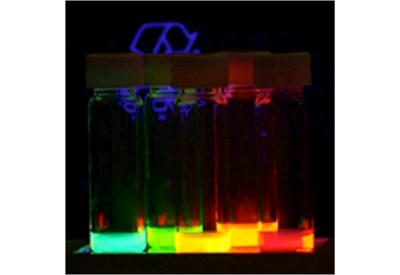
Manufacturing techniques being developed at Oregon State are dealing with the toxicity issue and should scale up to large volumes for low-cost commercial applications. They also will provide new ways to offer the precision needed for better colour control; the size and composition of the particle is what determines the colour of the light.
In this latest study, published in Materials Letters,* researchers created a superacid treatment that improves the photoluminescence of the non-toxic, non-heavy metal quantum dots to the point of being comparable with the best-performing quantum dot material, cadmium selenide.
“The light emission from the superacid-treated dots is much better,” says Herman, the study’s corresponding author. “There are still issues that need to be addressed, but what we’ve shown with this is the ability to improve the lifetime of the quantum dots, and much higher quantum efficiencies. And because these quantum dots are non-toxic, the potential exists for biomedical applications as well.”
A cancer patient, for example, could ingest highly stable dots that would collect at tumour sites to allow imaging.
“That’s another reason we’re working with copper and indium,” he said. “You don’t want people to ingest cadmium or lead.”
The National Science Foundation and Sharp Laboratories of America supported this research. Collaborators included then-OSU graduate students Yagenetfere Alemu and Gustavo Albuquerque.
Earlier quantum dot advances at Oregon State involved the development of a “continuous flow” chemical reactor, as well as microwave heating technology that’s conceptually similar to the ovens owned by most U.S. households.
The continuous flow system is fast and energy efficient and will cut manufacturing costs. And the microwave technology allows for precise control of the heat needed during the manufacturing process, translating into nanoparticles that are the size, shape and composition they need to be.
Steve Lundeberg reports on science news for Oregon State University. This article was first published online by OSU: http://today.oregonstate.edu/news/‘quantum-dot’-lighting-technology-takes-forward-leap-thanks-new-superacid-treatment
Photo source: Wikipedia; https://en.wikipedia.org/wiki/Quantum_dot_display
* Yagenetfere A. Alemu, Gustavo H. Albuquerque, Gregory S.Herman, “Enhanced photoluminescence from CuInS2/ZnS quantum dots: Organic superacid passivation,” Materials Letters, Volume 219, 15 May 2018, Pages 178-181, www.sciencedirect.com/science/article/pii/S0167577X18303173