What Do Your Customers Really Know About Light?
June 11, 2018
In honour of the International Day of Light, LEDVANCE has released the results of a recent international consumer study exploring their understanding of lighting technologies.
What do people know about lighting technologies? Or rather: what do they think they know? Do they know their watts from their kelvins and lumens? What do they think about the biological effects of light? A representative survey of consumers around the world, with over 3,000 surveyed in North America, shows that there is still a considerable lack of knowledge surrounding a number of different aspects of current and future lighting technologies.
UNESCO has declared May 16 as the International Day of Light, with the aim of making a global audience aware of the importance of light and lighting technologies. How do consumers rate their own knowledge of light? What causes the greatest confusion? And how open and up to date are they with regard to future issues of lighting technology? A recent representative survey conducted by Research Now on behalf of LEDVANCE answers these questions.
“Although light bulbs are considered as a commodity category product, we generally undervalue the importance of lighting to our daily life and well-being,” explains Wolfgang Mailaender, Head of Marketing for the United States and Canada, LEDVANCE. “At LEDVANCE, we try to communicate more on the lighting benefits of our products since human beings spend a lot more time under artificial lighting.”
Mailaender further explains, “With choice can also come confusion as demonstrated by the fact that our survey discovered that a majority of Canadians and Americans, 69% and 77% respectively, have at some time bought a lighting product for their household that was the wrong fit, shape, size, and/or light temperature. Our goal is to make it simpler for consumers to pick the right Sylvania light for the right application, whether it’s LEDs, smart LEDs or traditional. The good news is that people are turning to long-life, energy-efficient LED products, and in turn, saving energy and resources and helping to preserve our planet.”
Lack of knowledge about measurement units
Even though a majority has bought the wrong lighting product that they needed, most consumers think they are better informed than they really are: 71% of consumers in Canada and the United States responded that the advantages and disadvantages of different lighting technologies ranging from (smart) LEDs to classic incandescent lamps are completely or at least sufficiently clear to them.
When questioned on relevant measurement units such as the ones that have been printed on lamp or luminaire packaging for quite some time, the wheat was soon separated from the chaff: 77% of respondents in the United States and 80 percent in Canada were still able to correctly assign watts to energy consumption. Kelvin and lumen, on the other hand, which are important measurement units in the LED world, were only identified by about half – 58 percent in both the US and Canada and 58 percent in the US and 61 percent in Canada, respectively – as indications of color temperature and luminous flux.
According to Dr. Oliver Vogler, Head of Strategy and Marketing at LEDVANCE, this is a problem because “the color temperature and its kelvin value provide information about the light color – ranging from daylight white (from 5300 K) and cool white (3300 to 5300 K) to warm white (up to 2700 K). The luminous flux given in lumens tells you how much light the lamp gives out. So for energy-efficient LEDs, the crucial value for brightness is no longer watts, but lumens.”
Germany finished behind every other country when it came to identifying these measurements with only 33 percent of all respondents correctly assigned all the units. The British, French, Swedish, Americans, Canadians, Brazilians and Chinese on the other hand achieved between 40 and 50 percent. The Italians were top with 55 percent.
Shopping list surprises
If you are wondering which lighting technologies consumers are looking for at their local DIY store or on the internet, you would not be surprised to find LED technology – either with or without smart functions – high on the list. 58 percent of Americans and 55 percent of Canadians look for LED, and 31 percent and 26 percent look for Smart LED products. What is surprising, however, is that old technologies still feature prominently with
- · Halogen selected by 19 percent of both Americans and Canadians,
- · Fluorescent selected by 26 percent of Americans and 21 percent of Canadians, and
- · 18 percent of Americans and 16 percent of Canadians still stocking up on Incandescent light bulbs.
Human Centric Lighting: urgent need for information
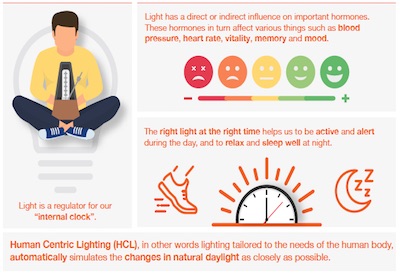
Human Centric Lighting (HCL) – or “the right light at the right time” – is one of the major trends right now in the lighting industry, and there is plenty of hype surrounding it. It is scientifically proven that artificial light that closely simulates the changes in natural daylight can help make a valuable contribution to establishing and stabilizing human day/night biorhythms, which can help boost our sense of well-being and improve our health.
In response to the question on the biological effect of artificial light on the human body, the majority of U.S. and Canadian respondents (around 72 percent) indicated however that they either did not believe it or knew nothing about it. Nevertheless, two thirds (66 percent) saw an advantage in using artificial light to stimulate body and spirit according to their individual needs. People are therefore generally open-minded about HCL. 62 percent of the respondents, for example, indicated that the biological effects of light would have a major influence on their purchasing decisions if they knew enough about it. However, that is obviously not yet the case.
In conclusion, Vogler added, “At LEDVANCE, we consider it our responsibility to provide more information on the huge contribution that good light can make on the well-being of each and every one of us.”
For more information go to https://www.ledvance.com/news-and-stories/stories/international-day-of-light/.
Image: a detail from a LEDVANCE infographic