Light Recycle Programs Proving Successful, but More Awareness Needed
The last few years have seen industry step-up to meet increasing environmental regulations, specifically in regards to extended producer responsibility programs.
For the uninitiated, extended producer responsibility (EPR) legislation requires producers to assume physical and financial responsibility for a product after it has ended its life cycle, lifting much of the burden off of municipalities. The law requires producers to either be a part of, or have their own, government approved EPR recycling program.
For light recycling, “Electro-Federation Canada, together with the EEMAC Lighting Section, recognized in 2008 that regulations were changing and some lamp products would be regulated as to how they were disposed,” explained Wayne Edwards, EFC VP Sustainability & Electrical Safety, in the association’s InfoElectric Spring 2014 and EFC Annual Report.
They selected not-for-profit industry association Product Care to design and manage lamp recycling programs for British Columbia, Manitoba and Quebec. “Each program is working well and continuing to enlighten Canadians in how to better protect the environment while offering convenient disposal to residential and C&I (QC and BC) sectors at no cost to them. All Canadians are winners,” Edwards said. Except that “all Canadians” may not even be aware that they can recycle their lights.
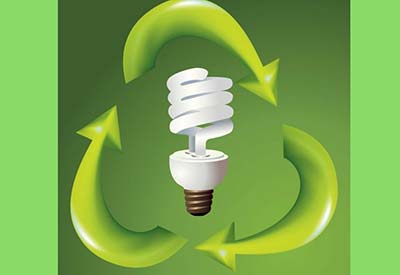
According to Mark Kurschner, president, Product Care Association, British Columbia has the most comprehensive industry led-light recycling program. Called “LightRecycle,” it was launched in 2010 and has been responsible for the diversion of more than 5.2 million used lights, he explained in InfoElectric Spring 2014 and EFC Annual Report.
A stewardship program, LightRecycle, is not-for-profit and entirely industry funded. British Columbia’s version of the program manages all aspects of recycling, from consumer and industrial collection sites and contracting with processors who disassemble the lights for reclamation and reuse, Kurschner explained. Its depot network has over 200 collection sites, including retailers, for-profit and non-profit recycling organizations, as well as local government recycling centres and transfer stations.
And it’s working. “In 2011, the program’s first full year of operation, 400,000 residential-use fluorescent lights and tubes were collected and B.C.’s per-capita collection rate increased to 0.09 units/per person,” Kurschner said, breaking down the numbers. “In 2012, when LightRecycle’s accepted products list expanded to include all light bulbs, ballasts, and fixtures used in the retail, industrial, commercial and residential sectors, that number went up to 0.27 units/person with a collection volume of 1.16 million units.” Recent data has the per capita collection rate at 0.82units per person based on 3,546,522 units collected, he said.
Meanwhile in Quebec, “RecycFluo” grabbed more than 3,000,000 end-of-life mercury containing lamps in its first year. The problem, however, is that majority of the Quebec population is unaware that mercury-containing bulbs can be recycled, “let alone where to take them,” Kurschner said, citing 2014 Omnibus Research.
Education about these recycling programs (and there’s a variation in every province) is “of paramount importance and needs to continue to be a priority for EPR program members,” Kurschner stressed. “The collection rate potential in the face of increased program awareness is simply astronomical.”